NASA's Artemis II Mission Successfully Launches, Carrying Historic Crew to Lunar Orbit
In a monumental achievement for space exploration, NASA's Space Launch System (SLS) rocket has successfully launched from Kennedy Space Center, carrying four astronauts on the first crewed Artemis mission. After resolving last-minute battery and safety concerns, the spacecraft has cleared the path for humanity's return to deep lunar exploration for the first time in over five decades.
Artemis II: Humanity's Return to the Moon
If all proceeds according to plan, Artemis II will represent humanity's first crewed journey near the Moon since the historic Apollo 17 mission in 1972. The astronauts are riding a fiery column into what many are calling a new era of spaceflight. Following liftoff, the Orion spacecraft has entered Earth orbit and will soon execute a translunar injection burn from its upper stage, propelling it toward a lunar flyby before beginning its return journey home.
The mission profile calls for the spacecraft to eventually re-enter Earth's atmosphere, culminating in a splashdown in the Pacific Ocean where recovery operations will commence. This critical test flight will validate systems and procedures essential for establishing a sustainable human presence on the Moon in future missions.

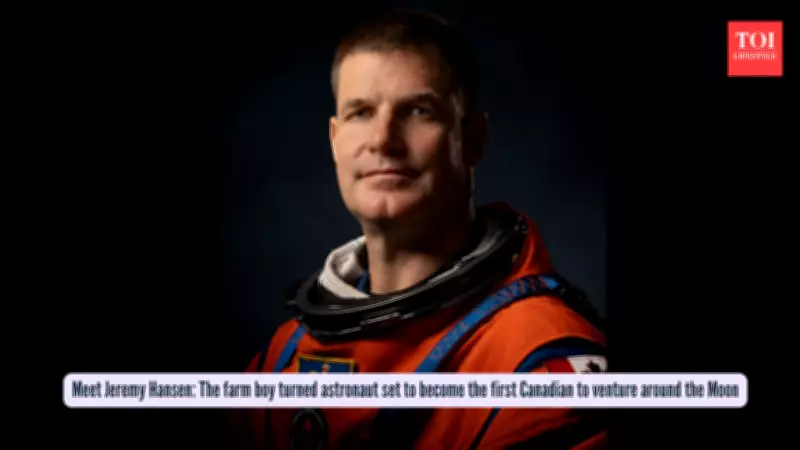
Jeremy Hansen: Making History as First Canadian to Orbit the Moon
Amid this groundbreaking mission, Canada is poised to make space history as Jeremy Hansen - a farm boy turned fighter pilot turned astronaut - is expected to become the first Canadian, and indeed the first non-American, to venture around the Moon. NASA's Artemis II mission places him alongside three fellow astronauts for a 10-day test flight that pushes human exploration further than ever before in the 21st century.
Who is Jeremy Hansen?
Jeremy Hansen, born January 27, 1976, grew up on a farm near Ailsa Craig, Ontario, before moving to Ingersoll for his high school education. Now a colonel in the Canadian Armed Forces, he's married with three children. According to the Canadian Space Agency biography, Hansen maintains an active lifestyle with passions including sailboat racing, rock climbing, and mountain biking.
Early Aviation Passion and Education
Hansen's aviation journey began early when he joined the 614 Royal Canadian Air Cadet Squadron at age 12. He earned his glider pilot wings at just 16 years old in Trenton, Ontario, and by 17, he held a private pilot license. This early passion led to his admission to the Royal Military College Saint-Jean.
Hansen's educational qualifications are equally impressive. He earned a Bachelor of Science in space science in 1999 and followed with a Master of Science in physics in 2000 from the Royal Military College of Canada, where his research focused on satellite tracking. He completed his CF-18 fighter pilot training in 2003 at the 410 Tactical Fighter Operational Training Squadron.
From Fighter Pilot to Astronaut
Hansen's professional journey saw him flying CF-18s with both the 441 and 409 Tactical Fighter Squadrons. He served as Combat Operations Officer at 4 Wing for NORAD, Arctic, and deployed missions. Selected in the Canadian Space Agency's 2009 recruitment campaign, he graduated from astronaut training in 2011 and subsequently worked as CAPCOM at Mission Control.
In 2013, Hansen participated in the European Space Agency's CAVES program, spending six days living underground in Sardinia, Italy. That same year, he flew the historic Hawk One F-86 Sabre to inspire youth about aviation and space exploration. By 2017, he achieved another milestone by becoming the first Canadian to lead a NASA astronaut class.
Meet the Complete Artemis II Crew
Hansen joins fellow astronauts Reid Wiseman, Victor Glover, and Christina Koch aboard the 32-story SLS rocket for this historic mission. Together, this diverse crew will fly thousands of miles beyond the Moon, looping back to Earth in under 10 days while conducting critical system tests that will pave the way for establishing a future lunar base and eventual missions to Mars.
The Artemis II mission represents not just a technological achievement but a symbolic return to lunar exploration that captures global imagination while testing the systems that will enable humanity's next giant leap in space exploration.