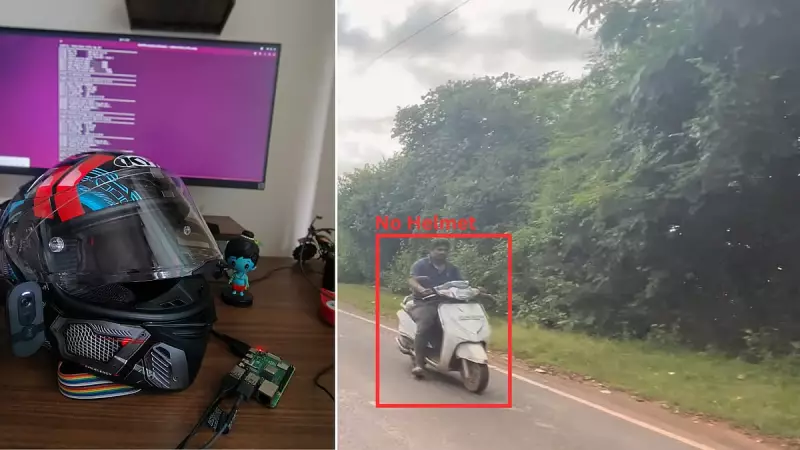
In a remarkable feat of ingenuity aimed at tackling Bengaluru's notorious traffic chaos, a city-based engineer has developed a prototype of a smart helmet powered by artificial intelligence. This innovative device is designed to automatically detect and report traffic violations, a move that has sparked significant excitement and been dubbed a 'super innovation' by netizens.
From Idea to Prototype: The Engineer's Vision
The brain behind this project is Shivam Sharma, a software engineer and resident of Bengaluru. Deeply concerned by the daily risks on the city's roads, Sharma dedicated his evenings and weekends over several months to bring his concept to life. His primary motivation was to create a tool that could assist in enforcing traffic rules more efficiently and objectively, potentially reducing accidents caused by common infractions.
The core of the helmet's functionality lies in its integrated AI system. Using a compact camera module and a processing unit, the helmet can scan its surroundings in real-time. The AI model has been trained to recognize specific traffic violations, with a current focus on identifying vehicles and two-wheelers that jump traffic signals.

How the AI-Powered Helmet Works
The operational mechanism of the smart helmet is straightforward yet technologically sophisticated. When the wearer, who could be a traffic officer, is stationed at an intersection, the helmet's camera continuously captures video footage. The onboard AI software analyzes this feed frame-by-frame.
Upon detecting a vehicle that proceeds through a red light, the system triggers an alert. The prototype is designed to log crucial details of the violation. This data includes:
- A timestamped video clip of the incident.
- The vehicle's license plate number (captured via image recognition).
- The GPS location of the violation.
This collected evidence is then stored securely and can be wirelessly transmitted to a central server or cloud database. This would provide traffic authorities with a digital, tamper-evident record of the violation, which could be used to issue e-challans or for further analysis of traffic patterns at problematic junctions.
Public Reaction and Future Roadmap
Since details of the project were shared online, the response has been overwhelmingly positive. Social media users, particularly on platforms like Twitter and LinkedIn, have praised Sharma's initiative. Many have highlighted the helmet's potential to act as a force multiplier for understaffed traffic police departments. Comments have ranged from calling it a "brilliant solution" to a "game-changer for Indian roads." This public validation has encouraged the inventor to pursue further development.
However, Shivam Sharma is clear that the current version is a working prototype. He acknowledges several challenges that need to be addressed before it can be deployed in the field. These include enhancing the AI's accuracy in diverse weather conditions and crowded environments, extending battery life for all-day use, and ensuring the device is robust and comfortable for prolonged wear.
The next phase involves seeking collaboration with the traffic police department or relevant government bodies for pilot testing. Sharma also aims to expand the AI's capabilities to detect other common violations such as illegal parking, wrong-way driving, and riders not wearing helmets. The ultimate goal is to create a scalable, cost-effective tool that contributes meaningfully to road safety and disciplined driving behavior in Bengaluru and beyond.
This grassroots innovation underscores how local engineers are leveraging cutting-edge technology like artificial intelligence to address pressing civic issues. It represents a promising step towards smarter, data-driven urban governance and safer streets for everyone.