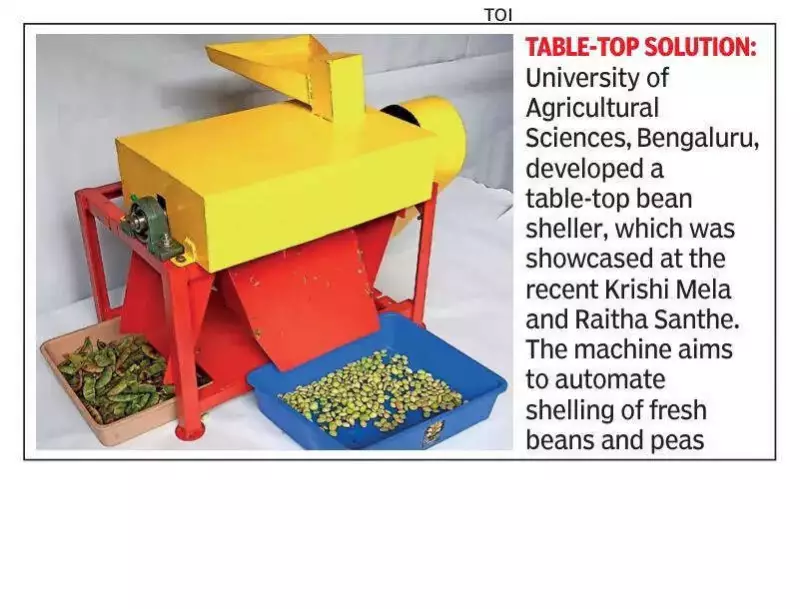
Residents of Bengaluru, particularly homemakers, farmers, and local food vendors, have received a significant reprieve from the tedious annual chore of shelling fresh beans and peas. The University of Agricultural Sciences, Bengaluru (UAS-B), has unveiled a groundbreaking, compact tabletop machine engineered to automate this labor-intensive process, which traditionally consumes countless hours during the peak avarekai season.
An Engineering Solution for a Seasonal Challenge
This innovative device is the brainchild of food processing engineers at the university, specifically designed to tackle the seasonal influx of fresh beans and peas in local markets. The machine efficiently shells hyacinth beans, popularly known as avarekai, and is also capable of handling pigeon peas, cowpeas, and common garden peas. Its public demonstration at events like the recent Krishi Mela and Raitha Santhe garnered positive attention, including commendations from Deputy Chief Minister DK Shivakumar and Agriculture Minister N Chaluvaraya Swamy.
The project was led by scientists Darshan MB and Manjunath M under the All-India Coordinated Research Project on Post-Harvest Engineering and Technology (AICRP-PHET). The six-month development initiative received funding with 75% support from the Indian Council of Agricultural Research (ICAR) and 25% from the state government.

Specifications, Cost, and Future Plans
The machine is powered by a 0.5 HP electric motor and boasts impressive operational metrics. It can process approximately 60 kilograms of bean pods per hour, yielding about 30 kilograms of shelled beans with an efficiency rate of around 90%. Scientist Darshan indicated that the estimated market cost for the device would range between Rs 20,000 and Rs 25,000.
The research team has already applied for a patent for their invention. "We are in the process of getting approvals for technology transfer to interested individuals or firms," stated Darshan, inviting potential collaborators to contact the university directly.
Next Phase: Integrating a De-Skinning Feature
Looking ahead, the engineers are not resting on their laurels. The next phase of development will focus on adding a de-skinning feature to the device. This upgrade is anticipated to be particularly beneficial for avarekai consumers in the region, where de-skinned beans are a culinary staple.
"We identified the challenge faced locally by households, retailers, and farmers, and decided to develop the solution. The machine, in its current form, is very useful in large kitchens during events and in restaurants," added Darshan, highlighting the practical, problem-driven origin of the project. This innovation stands to transform a routine kitchen struggle into a simple, efficient task, marking a notable advancement in small-scale food processing technology for everyday use.