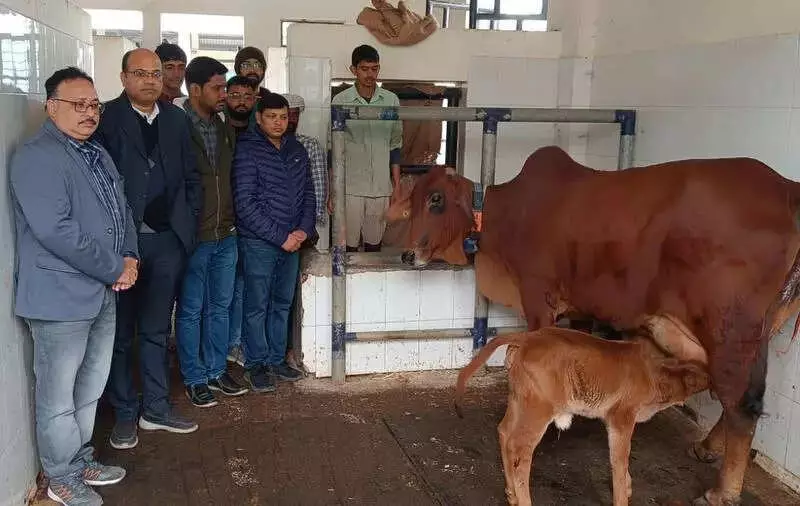
In a promising start to the new year, scientists at Banaras Hindu University (BHU) have achieved a significant breakthrough in indigenous cattle conservation. A healthy female Sahiwal calf was successfully delivered on January 1 at the university's dairy farm, using advanced reproductive technology.
A Milestone Birth for Indigenous Breeds
The newborn calf, weighing a robust 26.4 kg, was born through embryo transfer using sex-sorted semen. This event marks the sixth successful Sahiwal calf birth under a dedicated project run by the Faculty of Veterinary and Animal Sciences (FVAS) at BHU's Rajiv Gandhi South Campus in Barkachha, Mirzapur.
The project is part of the national Rashtriya Krishi Vikas Yojana (RKVY) and focuses on the conservation and genetic improvement of two key indigenous breeds: the Gangatiri and the Sahiwal. The latest birth underscores the steady progress being made in applying sophisticated cattle breeding technologies at the institution.

Leadership and Future Roadmap
The achievement was personally reviewed by senior university officials. Prof Amit Raj Gupta, Dean of FVAS, and Prof B M N Kumar, Professor In-Charge of RGSC, visited the newborn calf. They examined farm management practices and motivated the project team.
Prof U P Singh, Director of the Institute of Agricultural Sciences, praised the faculty's consistent dedication and results in preserving native cattle breeds. The project is spearheaded by Manish Kumar as the Principal Investigator, with Kaustubh Kishor Saraf and Dr Ajeet Singh serving as Co-Principal Investigators.
Next-Gen Technologies for a Self-Reliant India
Looking ahead, the faculty is planning to integrate even more advanced techniques to speed up genetic improvement. The roadmap includes adopting next-generation reproductive technologies such as:
- Ovum Pick-Up (OPU)
- In Vitro Embryo Production (IVEP)
The ultimate goal is to extend these technologies to local dairy farmers in the Vindhyan region. This initiative is expected to have a transformative impact by:
- Strengthening sustainable dairy farming practices.
- Enhancing rural livelihoods and income.
- Contributing to national objectives of food and nutritional security.
This concerted effort aligns perfectly with the broader vision of building an Atmanirbhar Bharat (Self-Reliant India), ensuring the preservation and enhancement of the country's valuable indigenous genetic resources in the livestock sector.