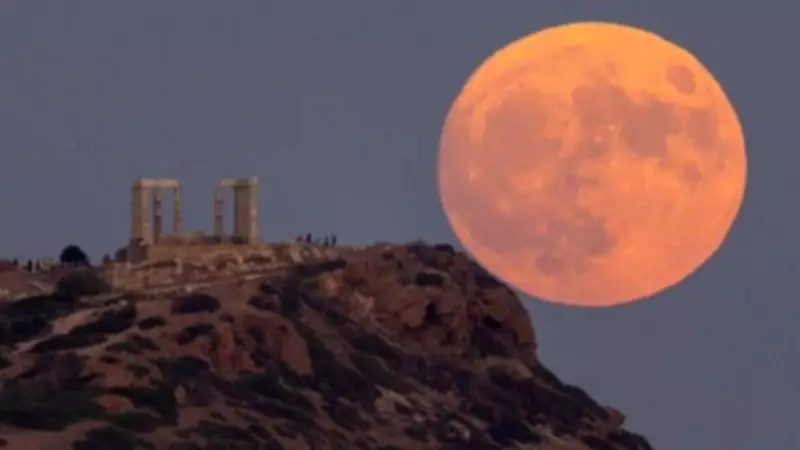
The term 'blue moon' captivates the imagination, evoking a sense of rarity and wonder. But what exactly is a blue moon? Is it a purely astronomical event, or does it carry deeper cultural significance? This article delves into the science behind this celestial phenomenon and its rich tapestry of traditions.
The Astronomical Definition
Contrary to popular belief, a blue moon does not refer to the moon's color. Astronomically, there are two definitions. The more common one is the seasonal blue moon: the third full moon in an astronomical season that has four full moons instead of the usual three. The other definition, popularized by a 1946 article in Sky & Telescope magazine, defines a blue moon as the second full moon in a calendar month. This occurs roughly every 2.5 years, making it a relatively rare event.
Why 'Blue'?
The moon can appear blue under certain atmospheric conditions, such as after volcanic eruptions or massive wildfires, when particles of a specific size scatter red light, allowing blue light to pass through. However, this is extremely rare and unrelated to the astronomical blue moon.

Cultural and Traditional Significance
Throughout history, the blue moon has been imbued with meaning. In folklore, it is often associated with change, magic, or supernatural events. Some traditions consider it a time for introspection and setting intentions. The phrase 'once in a blue moon' has entered everyday language to describe something that happens very rarely.
Global Perspectives
Different cultures have their own interpretations. In some Native American traditions, the blue moon is a time for storytelling and passing down wisdom. In parts of Europe, it was believed to bring good luck or, conversely, chaos. Modern pagan and Wiccan practices sometimes view the blue moon as a powerful time for rituals.
The Science Behind the Calendar
The occurrence of a blue moon is a quirk of the Gregorian calendar. Since a lunar cycle is about 29.5 days, and most months are 30 or 31 days, it is possible to have two full moons in one month. This happens because the calendar months are slightly longer than the lunar month. The next blue moon by the monthly definition is expected in August 2024.
Observing the Blue Moon
No special equipment is needed to see a blue moon. Simply look up at the sky on the night of the full moon. While it may not appear blue, its rarity makes it a special sight. Astronomers and skywatchers often use the occasion to host viewing events or share knowledge about lunar cycles.
Conclusion
The blue moon is a fascinating intersection of science and tradition. While astronomers define it by timing, cultures around the world have woven it into their stories and beliefs. Whether you view it through a telescope or simply gaze up with wonder, the blue moon reminds us of the beauty and mystery of the cosmos.