

Chandrayaan-3's Accidental Lunar Experiment Yields Crucial Scientific Data
In a remarkable turn of events during India's historic Chandrayaan-3 mission, the Vikram lander's brief "hop" maneuver on the lunar surface has become an unexpected scientific goldmine. What began as a routine end-of-mission procedure has now provided researchers with unprecedented insights into the Moon's subsurface composition and thermal characteristics.
The Three-Minute Hop That Changed Everything
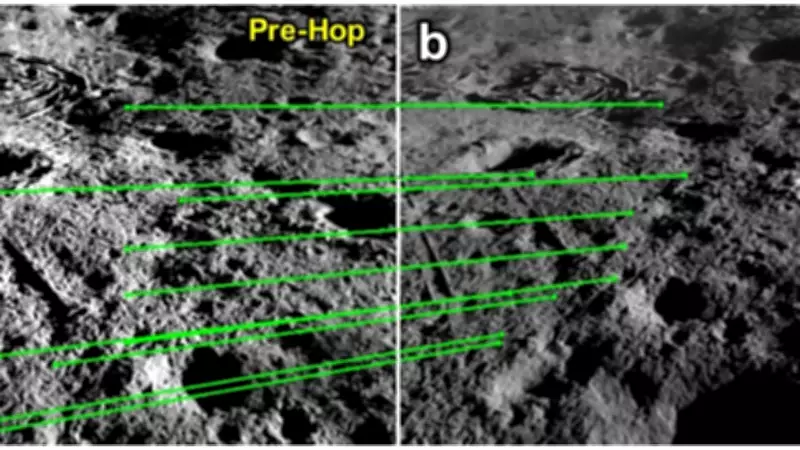
During the final stages of the Chandrayaan-3 mission in 2023, the Vikram lander executed a controlled lift-off and landing that lasted approximately three minutes. This seemingly simple maneuver shifted the spacecraft by about half a meter, creating a unique opportunity for comparative analysis between two adjacent lunar surface patches. The relocation proved particularly valuable because it allowed scientists to study both the original landing site and a previously undisturbed area within the same small crater.
Groundbreaking Measurements from ChaSTE Instrument
Following the hop, the Chandra's Surface Thermophysical Experiment (ChaSTE) temperature probe was deployed once more into the lunar soil. This time, only five of its ten sensors managed to penetrate the ground due to the steeper slope at the new location. Despite this limitation, the instrument successfully recorded thermal conductivity data during the brief window before lunar sunset, capturing approximately one lunar hour of observations with some interruptions caused by mission constraints.

The findings, published in The Astrophysical Journal by a research team led by K Durga Prasad at the Physical Research Laboratory, reveal several groundbreaking discoveries about lunar surface properties.
Layered Lunar Surface Structure Revealed
The data demonstrates that the Moon's surface is far from uniform. Instead, it consists of distinct layers with varying thermal properties:
- The uppermost few centimeters form a relatively conductive layer that transfers heat more efficiently
- The material immediately beneath this top layer shows significantly lower thermal conductivity
- This layered structure dramatically influences how the lunar surface heats during daylight hours and cools as night approaches
Unintentional Surface Modification Provides Additional Insights
The hop maneuver itself created an unexpected experimental condition. When Vikram fired its engines during the lift-off, the thrust force blew away approximately three centimeters of the topmost lunar soil, exposing denser material underneath. This accidental "excavation" revealed crucial information about soil compaction:
- Near-surface soil is loose and porous
- Within just a few centimeters depth, the material becomes significantly denser and more tightly packed
- Such variations in soil density could impact the stability of future landers and rovers
"The localized disturbance over just half a meter was particularly surprising," researchers noted, "as soil properties are typically uniform across such short distances on Earth."
Polar Region Differences from Previous Missions
The Chandrayaan-3 findings differ notably from data collected decades ago by Apollo and Surveyor missions at equatorial sites. These discrepancies suggest that the Moon's southern polar region, where Vikram landed, possesses unique characteristics that distinguish it from other lunar areas studied previously.
Twilight Temperature Observations
The ChaSTE probe also monitored temperature changes during lunar twilight. As sunlight faded, researchers observed a steady cooling period followed by a sharp temperature drop. The upper soil layer responded more rapidly to temperature changes than deeper layers, further confirming the structural differences within the lunar surface.
Implications for Future Lunar Exploration
These findings carry significant implications for future Moon missions, particularly those targeting the southern polar region where frozen water deposits may exist. Understanding thermal conductivity patterns helps scientists identify potential locations where water ice could remain stable beneath the surface.

The research also highlights the lunar surface's sensitivity to disturbance. Even a brief engine firing significantly altered the topsoil layer, exposing underlying material. Future missions involving sample collection or infrastructure development will need to account for these surface modification effects.
What began as a simple end-of-mission procedure has evolved into a valuable scientific experiment, demonstrating that even minor spacecraft movements can yield substantial insights into lunar geology and surface properties. The three-minute hop has provided researchers with a clearer understanding of the Moon's complex surface structure while highlighting the importance of adaptive scientific exploration.





