

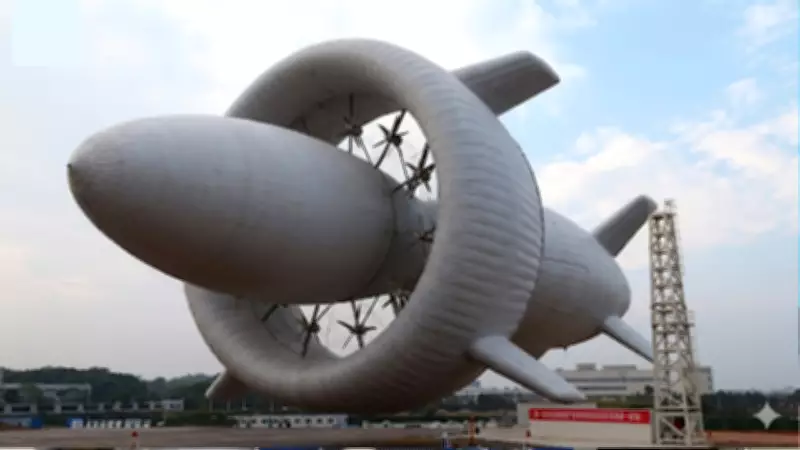
China Achieves World First with Megawatt-Class Airborne Wind Power System
China has reportedly achieved a groundbreaking world first by successfully testing a megawatt-class airborne wind power system capable of generating electricity while hovering an astonishing 2,000 meters above the ground. This technological breakthrough raises significant hopes for a new era of urban renewable energy solutions that could transform how cities harness wind power.
S2000 Stratosphere Airborne Wind Energy System Completes Historic Test Flight
The S2000 Stratosphere Airborne Wind Energy System (SAWES), an enormous aircraft-like structure spanning approximately 60 meters in length and 40 meters in both width and height, completed a successful test flight this week in the rugged terrain of Sichuan Province. During this critical trial, the innovative system not only generated electricity but also fed power directly into the local grid, marking a significant milestone for high-altitude wind technology development.
According to state and industry sources cited by Euronews, this achievement represents a major advancement in renewable energy technology. The system was developed by Beijing Linyi Yunchuan Energy Technology and functions as a hybrid between an airship and a wind turbine, designed specifically to tap into stronger and more consistent winds available at high altitudes.

Technical Specifications and Performance Details
During the test flight, the S2000 ascended for approximately 30 minutes and produced an impressive 385 kilowatt-hours of electricity. This performance demonstrates the system's potential to generate substantial power while operating at altitudes far beyond the reach of conventional ground-based turbines.
Weng Hanke, co-founder and chief technology officer of Beijing Linyi Yunchuan Energy Technology, explained the fundamental difference between this technology and traditional wind systems. "Traditional wind turbines operate by rotating their blades when wind strikes them, thereby generating electricity. This generator functions similarly, except that power generation occurs not at ground level but in the air," Weng stated in reports to Euronews.
Engineering Challenges and Transmission Solutions
The electricity generated aloft is transmitted to the ground via specialized overhead cables, a process that required overcoming significant engineering challenges. Weng emphasized that achieving this transmission capability demanded innovative solutions for maintaining lightweight construction while ensuring efficient medium-voltage direct current transmission from high altitudes to ground level.
These engineering breakthroughs represent critical advancements in airborne energy technology that could pave the way for more widespread adoption of high-altitude wind power systems in the future.
Additional Applications and Future Potential
Beyond power generation, the S2000 system is designed with multiple applications in mind. The technology can support communications and monitoring equipment, potentially aiding various low-altitude economic activities that require reliable aerial platforms for observation and data collection.
While the technology remains in the testing phase, reports suggest its developers and backers believe airborne wind systems could eventually help cities meet ambitious renewable energy targets by harnessing winds at altitudes previously inaccessible to traditional turbine technology. This could prove particularly valuable for urban environments where ground space is limited but high-altitude wind resources remain abundant.
The successful test represents a significant step toward making airborne wind power a practical component of global renewable energy strategies, potentially offering a new solution for sustainable power generation in densely populated areas where conventional wind farms face spatial limitations.






