

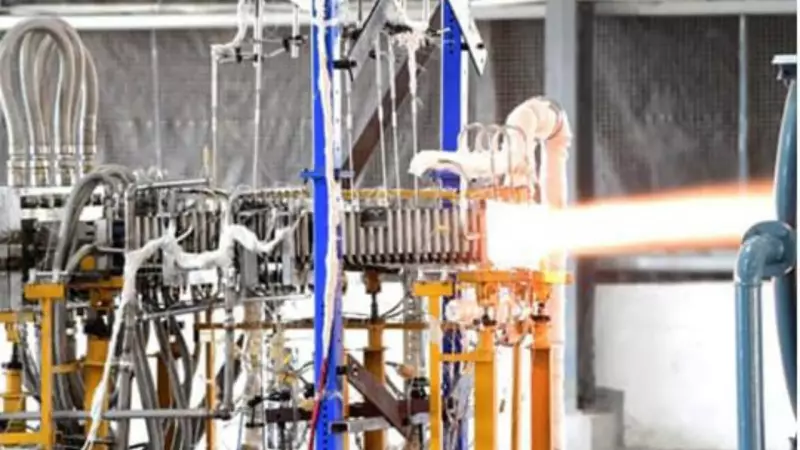
In a significant technological leap, India's Defence Research and Development Organisation (DRDO) has achieved a major breakthrough in its quest to develop advanced hypersonic weapons. The Hyderabad-based Defence Research & Development Laboratory (DRDL) successfully conducted an extensive, long-duration ground test of a critical engine component, marking a pivotal moment for the nation's aerospace capabilities.
A Landmark Test at the Scramjet Facility
On Friday, DRDL announced the successful completion of a rigorous ground test for its full-scale, actively-cooled scramjet combustor. The test was carried out at the state-of-the-art Scramjet Connect Pipe Test (SCPT) facility. The most remarkable aspect of this trial was its duration, with the combustor running continuously for over 12 minutes. This achievement builds directly upon a subscale test conducted on April 25 last year, representing a crucial scaling-up of technology.
The combustor is the heart of a scramjet engine, where fuel mixes with highly compressed air at supersonic speeds to ignite and produce immense thrust. Validating its design and performance under sustained conditions is essential for mastering the extreme thermal and pressure environments encountered during hypersonic flight.

Why This Scramjet Success Matters
This successful test places India among a select group of nations mastering this complex technology. A hypersonic cruise missile, powered by such an engine, can travel at speeds exceeding five times the speed of sound (Mach 5), which is over 6,100 kilometers per hour. Unlike traditional rockets that must carry heavy oxidizers, scramjet engines are air-breathing. They scoop oxygen from the atmosphere, allowing for lighter vehicles and much longer ranges.
Defence Minister Rajnath Singh was quick to applaud the achievement. He complimented DRDO, its industry partners, and academia, stating that this milestone provides a "solid foundation for the nation’s hypersonic cruise missile development programme." DRDO Chairman Samir V Kamat also congratulated the teams involved in this complex project.
Foundations for Future Hypersonic Capabilities
The DRDO, in its official release, highlighted that the ground tests have successfully validated not only the design of the advanced scramjet combustor but also the capabilities of the cutting-edge SCPT test facility itself. The combustor and the test infrastructure were designed and developed by DRDL and brought to reality with the help of industry partners.
This breakthrough is a clear indicator of India's growing self-reliance in cutting-edge defence technology. Mastering scramjet propulsion is a critical step towards developing a new class of high-speed, long-range missiles that are exceptionally difficult to intercept, thereby significantly enhancing the country's strategic and tactical deterrent capabilities.






