

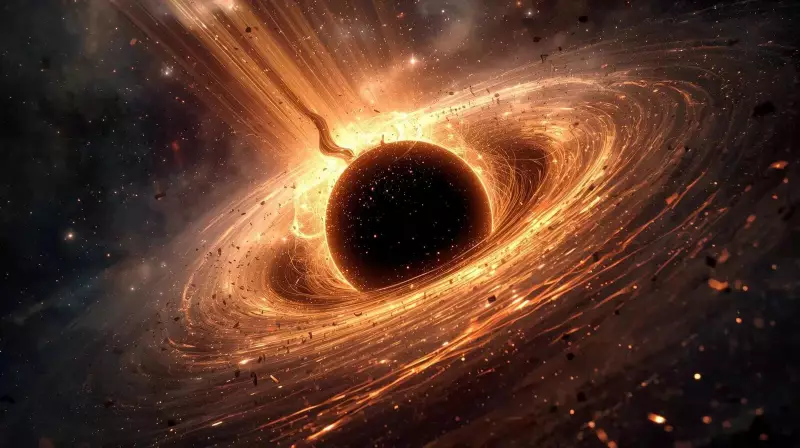
In a quiet cosmic revelation, astronomers have finally witnessed a phenomenon predicted by Albert Einstein over a century ago. The observation came not with a bang, but through the meticulous study of a distant star's violent end, revealing that a spinning supermassive black hole twists the very fabric of space and time around it.
The Wobble That Revealed a Cosmic Truth
The discovery began with a tidal disruption event (TDE), a cataclysmic occurrence where a star drifted too close to a supermassive black hole and was shredded into streams of gas. This material formed a hot, bright disc around the black hole, with jets of matter ejected at extreme speeds. While TDEs are known, this one, observed in a faraway galaxy, behaved strangely.
The data showed an unusual pattern. Instead of remaining steady, the signals rose and fell. Both the accretion disc and the jets were wobbling in unison on a slow, repeating cycle of approximately twenty days. This shared, rhythmic motion pointed to an external force—not a collision, but a fundamental drag caused by rotation.

Einstein's Frame Dragging Moves from Theory to Reality
This wobble is the signature of frame dragging, an effect Einstein's theory of general relativity predicted. It states that a massive, spinning object should pull space and time along with it. Near a black hole, where gravity is extreme, this effect should be most pronounced. For decades, it remained an inferred concept, but this observation provides clear, physical evidence.
The precession, or wobble, of the disc and jets matched precisely what theoretical models expected from a spinning black hole warping its surrounding spacetime. This confirms that space is not a static stage but a dynamic entity that can be bent, moved, and flowed by immense mass and spin.
How Telescopes Spotted the Subtle Signal
Capturing this subtle effect required a multi-wavelength approach. Researchers, who published their findings in Science Advances, combined X-ray data from a NASA space telescope with radio observations from a large ground-based array. This combined view revealed changes that didn't fit normal TDE patterns.
Spectral analysis showed the coordinated precession, ruling out chaotic explanations. The consistent pattern across different instruments and over time pointed conclusively to spacetime itself being dragged by the black hole's powerful spin.
Implications for Understanding Black Holes and Galaxies
This finding transforms our view of black holes from simple endpoints to active shapers of their environment. The spin of a black hole influences how matter falls in, how energetic jets form, and how energy is redistributed.
Understanding frame dragging is crucial for refining models of galaxy evolution and how supermassive black holes interact with their host galaxies. It demonstrates that the universe's most extreme predictions are not mere mathematical curiosities but observable realities, given enough patience and the right tools.
The discovery doesn't close a book; it opens a new chapter. Far away, the destruction of a single star has quietly validated an idea that waited more than a hundred years for its moment in the cosmic spotlight.






