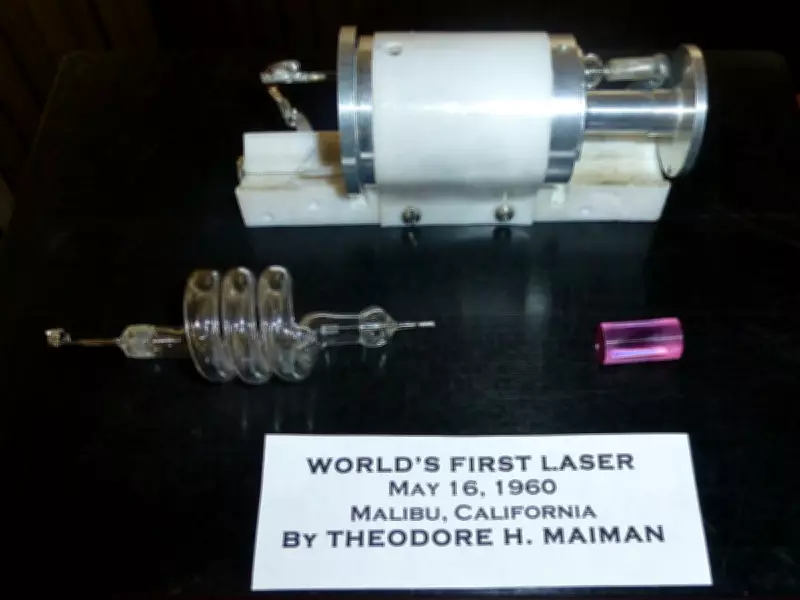
In the summer of 1960, physicist Theodore H. Maiman conducted a laboratory experiment at Hughes Research Laboratories that produced the first laser beam. Using a high-energy flashlamp and a small synthetic ruby crystal, he generated a short burst of intense light. This event is widely regarded as the creation of the first laser beam. Lasers now play an essential role in internet infrastructure, surgery, and retail scanning.
Proving the Theory
Until Maiman's experiment on May 16, 1960, lasers had not yet been demonstrated in practice. Scientists around the world had attempted to create a system that amplified light to form an intense beam. Maiman's experiment showed that a ruby rod could be used to produce laser light. As noted in a historical review indexed in PubMed, Maiman's ruby laser was considered a crucial achievement that launched the laser era. The invention demonstrated that focused light could be generated efficiently and adapted for many uses. It was the exact achievement that turned the laser into an extensive technological platform and helped researchers study other wavelengths and materials.
Revolutionizing Modern Medicine
The first major change came when laser precision moved from physics laboratories into clinical practice. Doctors quickly recognized that a well-controlled beam of light could be used inside the body with less damage to surrounding tissue. Medical history records suggest that urology and dermatology were among the first specialties to use lasers. Based on ruby laser technology, specialists developed complex procedures. As mentioned in a clinical study indexed by PubMed, the arrival of usable laser energy led to further developments in medicine, such as endoscopic stone treatment and organ-saving cancer removal. Decades later, this discovery became an important basis for innovative skin procedures aimed at removing various skin pigments and tattoos.

From Data Transmission to Shopping
Lasers soon extended beyond the surgical theater and became a vital force in global communications. As technology advanced, scientists learned to use lasers for data transmission through thin glass fibers. This led to fiber-optic systems capable of carrying internet traffic across continents and oceans. Laser technology evolved further and became part of everyday life. The same basic principle later appeared in optical devices used for barcode scanning, manufacturing equipment, and anti-counterfeit markings.
A Lasting Legacy
This 1960 experiment remains important because it was scalable. Maiman did not build an enormous, complicated device for a single purpose. He developed a tool that could later be improved upon and scaled up by other inventors. Although ruby lasers were later replaced by more efficient gas, liquid, and semiconductor lasers, modern laser systems still rely on the same basic principle. The tiny red crystal did little more than emit a beam of light for a second or two in Maiman's laboratory, but it gave humanity a new way to use light.