Gando Baval: From Ecological Scourge to Green Energy Catalyst in Gujarat
In a remarkable twist of ecological fate, the highly invasive gando baval (Prosopis juliflora), long reviled for ravaging Gujarat's fertile lands and causing immense environmental distress, is emerging as an unlikely cornerstone of India's ambitious green energy transition. This thorny, resilient tree, often dubbed 'mad' for its aggressive spread, now lies at the heart of a pioneering green methanol project at the Deendayal Port Trust in Kandla, positioning India not merely as a consumer but as a potential global hub for sustainable fuel production.
The Ecological Challenge and Unchecked Expansion
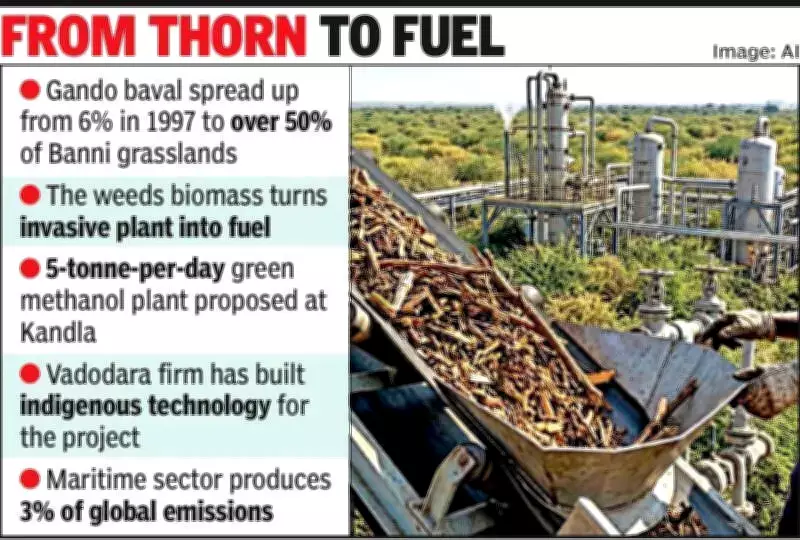
Originally introduced in 1961 to combat desertification and halt the advance of the Rann of Kutch, gando baval has ironically become an ecological menace. Its unchecked proliferation has overwhelmed vast stretches of the Banni grasslands, with coverage exploding from a mere 6% in 1997 to over 50% today. This rampant growth has displaced native flora, disrupted fragile ecosystems, and necessitated costly, sustained restoration efforts across the region.
Innovative Transformation into Green Methanol
This very biomass, once considered a liability, is now being harnessed as feedstock for a five-tonne-per-day (TPD) green methanol demonstration plant. Developed at Deendayal Port with indigenous technology from Vadodara-based Ankur Scientific in partnership with Thermax Energy, the project represents a rare convergence of environmental management and industrial innovation.

At its core lies a sophisticated two-stage process:
- Biomass, including gando baval, is converted into syngas—a mixture rich in hydrogen and carbon monoxide.
- This syngas is then catalytically transformed into methanol, a clean-burning fuel.
"The starting point itself changes—from fossil fuels to locally available biomass," emphasized Ankur Jain, Managing Director of Ankur Scientific, highlighting the paradigm shift in feedstock sourcing.
Strategic Importance for Shipping and Energy Security
With commissioning anticipated by late 2026 or early 2027, the Kandla project places India at the forefront of the global clean fuel transition. Kandla is poised to play a pivotal role in the proposed green shipping corridor linking Rotterdam and Singapore, serving as a testbed for low-emission maritime trade. The global shipping industry, responsible for nearly 3% of total greenhouse gas emissions, urgently needs cleaner alternatives. Methanol stands out as a viable solution, capable of:
- Slashing carbon dioxide emissions by up to 95%
- Reducing nitrogen oxides by approximately 80%
- Virtually eliminating sulphur oxides and particulate matter
The global green methanol shipping market, valued at $5.85 billion in 2025, is projected to surge past $46 billion by 2034, driven largely by Asia-Pacific nations through policy incentives and fleet investments. India's recent amendment to its shipbuilding framework, offering up to 30% financial assistance for vessels powered by green fuels like methanol, aligns with strategies adopted by maritime leaders such as China, Japan, and South Korea.
Broader Implications for Energy Independence
Beyond maritime applications, the project addresses critical energy security concerns. As geopolitical tensions disrupt global supply chains, India's heavy reliance on imported fuels—particularly LPG—remains a strategic vulnerability. Green methanol offers a promising hedge through its derivative, dimethyl ether (DME), which can be blended with LPG at ratios of 10% to 20%. This approach not only reduces import dependency but also leverages abundant domestic biomass resources, transforming an ecological problem into an energy solution.
India's annual methanol demand stands at 2.8 million tonnes and is rising, underscoring the urgency for domestic production. The Kandla initiative, by converting a pervasive invasive species into a valuable resource, exemplifies how environmental challenges can be reframed as opportunities for sustainable industrial growth, positioning Gujarat as a laboratory for India's green energy ambitions.