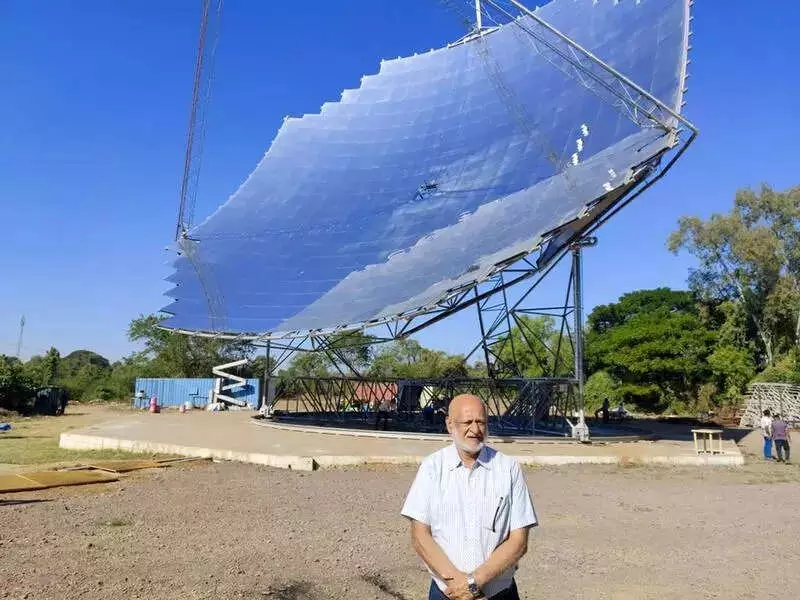
In a remarkable demonstration of sustainable energy adoption, a spiritual retreat near Vadodara is now home to some of the world's largest solar concentrators. This initiative is steadily replacing conventional power sources with clean solar energy, showcasing a successful blend of global technology and India's manufacturing prowess.
From Australian Labs to Indian Soil
The journey of these giant solar dishes began at the Australian National University in collaboration with a company named Sunrise CSP. Deepak Gadhia, a board member at the Muni Seva Ashram in Goraj, Vadodara, explained that while a prototype was built in Australia, the technology did not gain commercial traction there due to cheaper coal-based energy.
The turning point came when Sunrise CSP representatives visited India's Dholera Special Investment Region (SIR) for a desalination project. Gadhia, who left his manufacturing business to join the ashram, agreed to collaborate on a strict condition: the project must adhere to the 'Make in India' philosophy. This led to the establishment of an Indian subsidiary and the eventual manufacturing of the concentrators locally.

Engineering Marvels Driving Daily Operations
The first solar concentrator, installed at the ashram three years ago, is a colossal structure. Measuring 26 meters in diameter and standing as tall as a seven-storey building, it uses mirrors to concentrate sunlight and produce high-temperature steam.
Initially, this steam was channeled for cooking, laundry, and other daily needs. Encouraged by its success, the ashram installed an even larger second dish. This unit is powerful enough to run a massive 200-tonne air conditioning plant. The Rotary Club of Bombay Pier provided significant support for this expansion, contributing Rs 1.6 crore to the project.
Scaling Up with Global and Government Support
The ashram's green energy project is set to grow further. Two more solar concentrators are planned for installation. The United Nations Industrial Development Organisation (UNIDO) has donated Rs 2.5 crore towards this initiative.
Gadhia also revealed that the ashram's hospital, registered as an MSME (Micro, Small & Medium Enterprise), will receive a 50% government grant for the project. The model is inspiring industrial adoption as well, with two industrial units in Hyderabad now installing similar concentrator systems.
A key advantage of this technology is its space efficiency. Gadhia likened it to replacing several small houses with a single high-rise on the same plot of land. The dishes are fitted with intelligent software that allows them to track the sun's path automatically, ensuring they capture maximum solar energy throughout the day.
This Vadodara-based project stands as a testament to how globally innovated technology can be adapted and manufactured locally to address India's unique energy challenges, creating a sustainable and self-reliant model for the future.