From Humble Beginnings to Lunar Ambitions: The Century-Long Rocket Journey
On a serene farm field in Auburn, Massachusetts, a visionary physics professor meticulously assembled a homemade rocket designed to be powered by gasoline and liquid oxygen. On March 16, 1926, this modest machine briefly roared to life, ascending a mere 41 feet before touching down. Despite its limited flight, this event marked a pivotal moment in the annals of rocket history, igniting the era of modern rocketry.
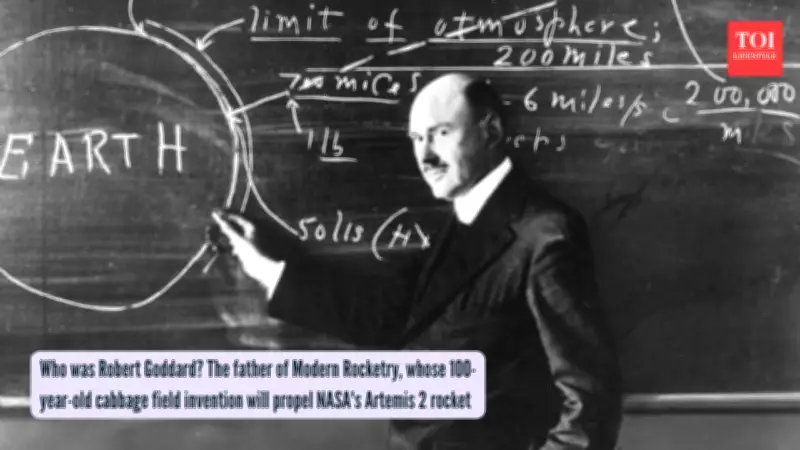
The Father of Modern Rocketry: Robert H. Goddard
Robert H. Goddard, the unassuming inventor behind this breakthrough, launched the world's inaugural liquid-fueled rocket from what was colloquially known as a 'cabbage patch.' The 10-foot-tall device, affectionately dubbed "Nell," consumed gasoline and liquid oxygen, achieving a climb of 41 feet in just 2.5 seconds and landing 184 feet away, as documented in NASA's historical records.
Witnessed by his wife Esther, crew chief Henry Sachs, and Clark University colleague Percy Roope, Goddard captured the milestone in his diary, noting, "The first flight with a rocket using liquid propellants was made yesterday at Aunt Effie's farm in Auburn." This brief 'hop' demonstrated the viability of liquid propellants, offering advantages over solid fuels that burn uncontrollably once ignited.

Goddard's groundbreaking innovations, including turbopumps, gimbaling engines, and gyroscopic guidance systems, became the cornerstone of rocketry, as highlighted by the National Air and Space Museum. Initially mocked for his lunar aspirations, his ideas eventually fueled missiles, satellites, and the Apollo moon landings within five decades.
Enduring Principles: From Nell to NASA's SLS
Liquid-fueled rockets excel by enabling throttle control and delivering greater thrust, as the fuel and oxidizer mix in a combustion chamber, ignite, and expel through a nozzle. This fundamental principle, pioneered by Goddard, remains integral to contemporary space missions.
Fast forward to March 2026, approximately a century later, and NASA's colossal Space Launch System (SLS) rocket, standing 30 times taller than Nell, prepares for launch from Kennedy Space Center's Complex 39B. Utilizing the same liquid oxygen and fuel combination that Goddard first harnessed, albeit augmented with solid boosters, the SLS is set to propel the Artemis 2 mission.
Rolled out to the launch pad on January 17, 2026, the mission targets a launch window around April 1-6. Artemis 2 will send four astronauts aboard the Orion spacecraft on a lunar flyby, testing life support systems in preparation for Artemis 3's planned 2027 docking and Artemis 4's 2028 moon landing.
Legacy and Impact: Goddard's Vision Realized
Hailed today as the 'Father of Modern Rocketry,' Goddard's contributions extend beyond his inventions. He inspired the establishment of NASA's Goddard Space Flight Center in Maryland, and his design philosophy, such as positioning the engine at the base for stability, continues to influence rocket engineering, as noted by the Smithsonian Institution.
From a quiet cabbage field to the forefront of lunar exploration, Goddard's legacy exemplifies how foundational scientific principles can transcend time, driving humanity's quest to reach new celestial frontiers. As Artemis 2 readies for its journey, it stands as a testament to the enduring power of innovation born from humble origins.