

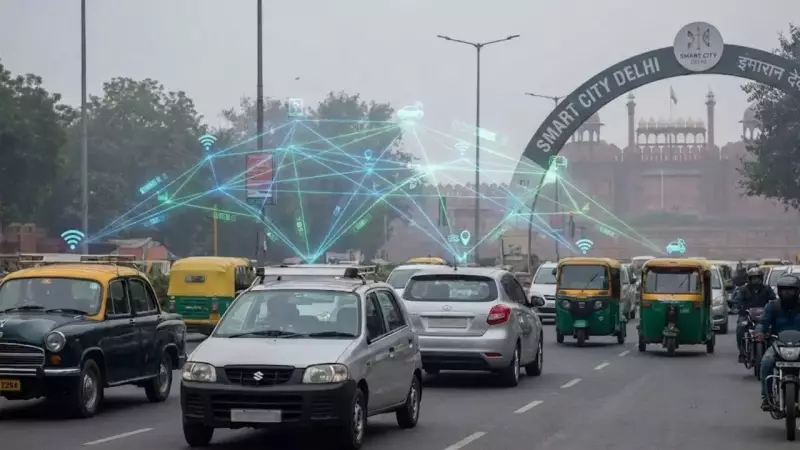
In a significant move aimed at curbing accidents and enhancing safety on Indian roads, the central government has announced plans to introduce advanced vehicle-to-vehicle (V2V) communication technology. The initiative, spearheaded by the Ministry of Road Transport and Highways, is part of a broader push to leverage technology for safer transportation infrastructure across the country.
What is V2V Communication and How Will It Work?
Union Minister for Road Transport and Highways, Nitin Gadkari, has revealed that the government is actively working on this framework, with an expected rollout timeline set for by the end of 2026. Unlike many current connected car features that depend on cellular networks or internet connectivity, this V2V system is designed to function independently.
The technology will enable vehicles to talk directly to each other using short-range wireless signals. This peer-to-peer communication does not rely on network coverage, meaning it will work effectively even in remote areas with weak or no mobile signals. The ministry's plan involves equipping vehicles with a dedicated hardware module to facilitate this direct data exchange.

Real-Time Hazard Alerts and Accident Prevention
When vehicles come within a certain proximity, these modules will allow them to share critical real-time data instantly. The information exchanged will include:
- Precise location and direction of travel
- Current speed
- Braking activity
This data is processed immediately within the vehicles to identify potential risks. For instance, if a car ahead applies sudden brakes or if traffic slows down unexpectedly on a highway, the system can provide an early warning to the driver behind. This is crucial in scenarios where human reaction time is limited, such as:
- Sudden stoppages on high-speed corridors
- Stationary vehicles on fast-moving roads
- Situations where judging distance or speed accurately is challenging
Enhancing Safety in Adverse Conditions
The implementation of V2V communication technology is poised to be a game-changer, particularly during low-visibility conditions that plague many parts of India. In dense fog, heavy monsoon rains, or poor lighting, where a driver's line of sight is severely compromised, the system can "see" and communicate the presence, speed, and actions of nearby vehicles. This provides a critical safety net that complements human perception.
By enabling cars, trucks, and other vehicles to become aware of each other's actions beyond the driver's immediate field of vision, the technology aims to prevent chain-reaction collisions and offer drivers valuable seconds to react. The government's focus on this direct communication standard underscores a commitment to adopting proactive, tech-driven solutions to address India's road safety challenges, potentially saving thousands of lives annually.






