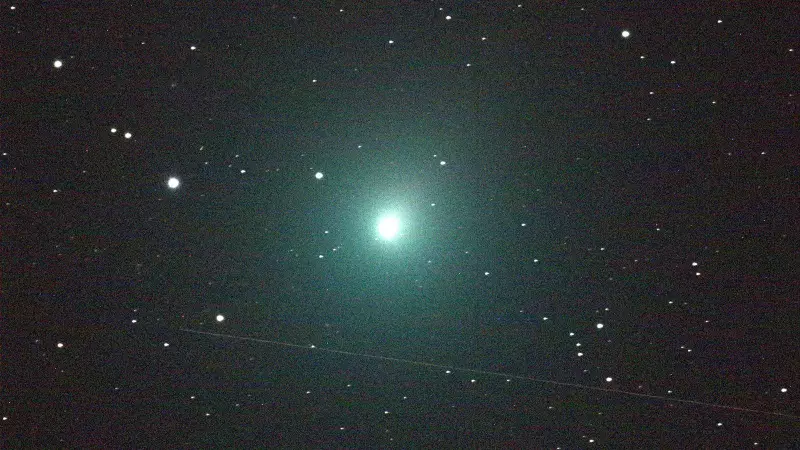
The celestial wanderer known as comet 3I/ATLAS has re-emerged from behind the sun, presenting astronomers with a rare opportunity to study an authentic interstellar visitor. This mysterious green-hued comet recently completed its closest approach to our sun and is now revealing fascinating details about its composition and behavior that have scientists buzzing with excitement.
The Cosmic Traveler's Green Glow Explained
On Wednesday, November 5, researcher Qicheng Zhang from the Lowell Observatory in Arizona captured stunning new images of the comet using the facility's powerful Discovery Telescope. What makes this interstellar object particularly captivating is its distinctive green coloration, which scientists have now confirmed results from diatomic carbon molecules within its atmosphere.
The comet contains numerous large hydrocarbons—complex molecules composed of hydrogen and carbon atoms that break apart when exposed to the sun's intense ultraviolet radiation. Zhang explained this process using a relatable analogy: "It's similar to how our skin gets sunburned when we stay too long in the sun without protection. The UV rays damage our DNA, which, like these hydrocarbons, are large carbon-based molecules."

When this molecular breakdown occurs on the comet, it releases diatomic carbon—pairs of carbon atoms bonded together that emit a characteristic green glow visible through specialized filters.
Solving the Mystery of the Missing Tail
Recent observations presented another puzzle: the comet appears to be missing its characteristic dust tail. Instead, 3I/ATLAS displays an asymmetric brightness pattern that appears stronger on its left side. However, astronomers confirm this is merely an optical illusion rather than an actual absence.
The tail does exist but lies directly behind the comet, slightly curved toward the left, creating a head-on perspective that makes it difficult to observe from Earth. This unusual orientation provides valuable information about the comet's trajectory and the forces acting upon it as it speeds away into interstellar space.
An Ancient Visitor from Beyond Our Solar System
Since its discovery in July, 3I/ATLAS has captivated the scientific community as a confirmed interstellar object—only the third such visitor ever recorded. This cosmic traveler likely originated from a distant, unidentified stellar system within the Milky Way and may be up to three billion years older than our own solar system, making it a precious relic from the cosmic past.
The comet reached perihelion—its closest approach to the sun—on October 29 before reappearing in early November. This period typically represents peak activity for comets as solar radiation heats their icy cores, causing frozen materials to transform directly into gas and dust that forms the characteristic coma or atmosphere around the nucleus.
Zhang conducted the first optical observations of 3I/ATLAS after its perihelion passage on October 31, capturing the comet at dawn as it drifted northward from the northeastern horizon. Preliminary data suggests that 3I/ATLAS may have developed a thick, irradiated outer crust from prolonged exposure to cosmic radiation during its interstellar journey.
This hardened exterior means the comet might now be releasing altered material rather than pristine samples from its original star system, providing clues about the conditions in its home solar system and the transformations that occur during long-distance space travel.
Brightness Changes and Observational Opportunities
Earlier observations revealed intriguing patterns in the comet's behavior. On October 28, Zhang and a colleague published findings describing a rapid brightening of 3I/ATLAS before perihelion and a noticeably blue hue relative to our sun. Their analysis confirmed that the comet's blue appearance corresponds to shorter wavelengths of light.
The comet appears significantly brighter through blue-green filters that capture these shorter wavelengths most effectively. While only large telescopes like the Lowell Discovery Telescope could observe the comet immediately after perihelion, its changing position in the sky now makes it accessible to many observatories and even skilled amateur astronomers using 6-inch (15 cm) telescopes.

This increased visibility opens up exciting opportunities for continued observation as 3I/ATLAS continues its journey back into the depths of interstellar space, carrying with it secrets about the chemical composition and evolutionary history of planetary systems beyond our own.