

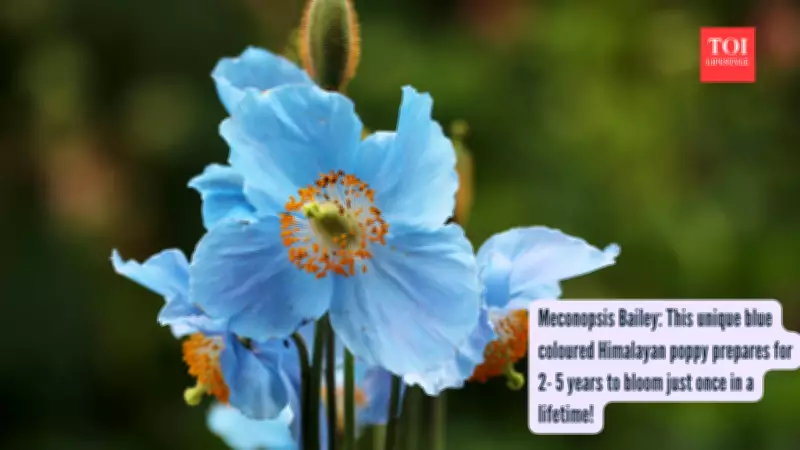
Blue is one of those soothing colors that stands as a quiet rebel in nature. It has a shorter wavelength and scatters more in nature, imparting colors to the sky and water bodies. Although these parts of nature may be blue, you might have observed that not many naturally occurring blue creatures or substances are widely prevalent. Even among flowers, fewer than one in ten dares to be blue, making chance encounters with blue blooms lasting memories. However, one unique and rarely found blue flower grows in the harsh, biting cold of the Himalayas: the Himalayan blue poppy. This flower embodies beauty in rarity, painting the mountainous silence with its otherworldly glow.
A Rare Blue Wonder Found in Extremes
The Meconopsis baileyi, or Himalayan blue poppy, grows in cold regions of the Himalayas where normal life seems nearly impossible. This beautiful flower is found between 3,000 and 4,500 meters across Tibet, Bhutan, Nepal, India's Ladakh, Sikkim, and Arunachal regions, southwest China, and Myanmar. These regions remain cool, moist, and have acidic alpine meadows suitable for its growth. Its mesmerizing cup-shaped petals cradle a sunny yellow center, sitting atop stems reaching a meter high, dusted with fine hair that faces fierce winds and biting cold. Some plants are patient by nature, storing necessary nutrients over time. Similarly, this poppy spends two to five years storing energy deep underground, unveiling its bloom for just days amid snowmelt—often a once-in-a-lifetime show before gently fading away.
When Was the Flower Discovered?
According to the Royal Botanic Garden Edinburgh, British explorer Frederick Marshman Bailey spotted the flower in 1913 in eastern Tibet. It was named after him, even though it remained hidden for many years. After the discovery, word spread quickly. Later, plant hunter Frank Kingdon-Ward collected seeds, introducing the flower to Europe by 1926, where it was presented at horticultural shows.

Tibet's National Flower
The Himalayan blue poppy is also Bhutan's national flower and symbolizes purity. Tibetan tradition links it to patience, and it is used in Tibetan medicine for pain and breathing, though research still lags behind.
Surviving the Harshest Conditions
The flower grows in biting cold conditions where survival is tough, and the same traits that help it survive also leave it exposed. It depends on cold, moist conditions that are becoming harder to find as temperatures rise and snowfall patterns change due to global warming. These needs also make it difficult to grow elsewhere. Steady moisture, cool air, and shelter from heat are tough to match outside its home. High in the mountains, one plant might still be gathering strength year by year, waiting for its one chance to bloom. When it does, it gives a blue so rare that nature saves it for special moments.






