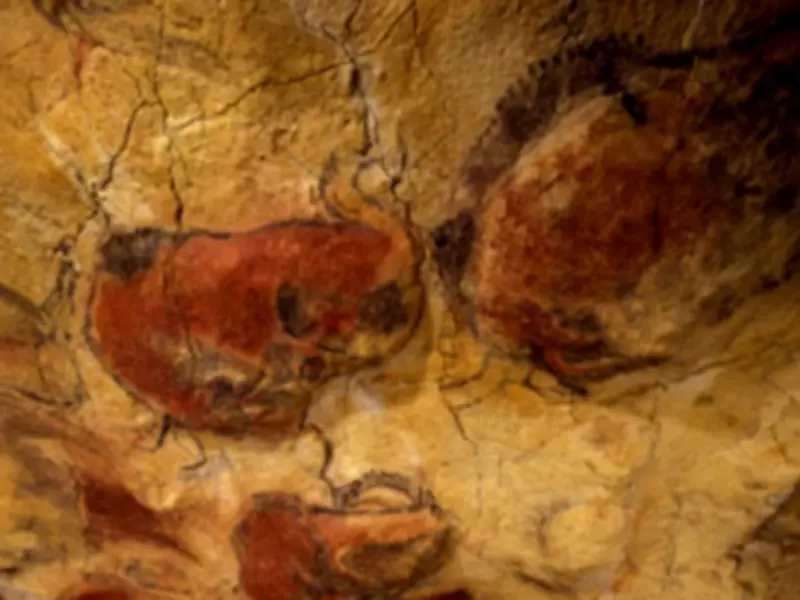
In the summer of 1879, an eight-year-old girl entered a cave in northern Spain and looked up. That simple act helped change archaeology forever. While amateur archaeologist Marcelino Sanz de Sautuola explored the Altamira Cave in Cantabria, his daughter María wandered through the chamber, her eyes catching something her father had missed. Above her head, adorning the low ceiling, were spectacular images of bison painted in red and black. The animals seemed to flow across the rock, their shapes determined by the natural contours beneath. What María had discovered was not merely a hidden gallery of images; it challenged the deepest assumptions about Stone Age people and revealed that those living at the end of the last ice age were sophisticated artists.
The Moment That Changed Everything
Altamira Cave was first discovered in 1868 by local hunter Modesto Cubillas, but its true significance remained unrecognized until 1879, when María Sanz de Sautuola spotted the painted bison on the ceiling. The discovery immediately captivated Sautuola. Using his knowledge of stone tools and animal bones from his excavations, he realized the importance of the paintings. He published his findings in 1880, concluding that the artwork dated to the Palaeolithic period. The scientific community's response was immediate and dismissive. Many believed that humans living during the ice age lacked the artistic ability to produce such detailed works. The art seemed too sophisticated, too detailed, and too eye-catching to fit 19th-century ideas about ancient ancestors. According to contemporary accounts, many prehistorians considered the artwork a modern fraud rather than genuinely ancient.
Why Were the Paintings So Convincingly Modern?
A major reason for this disbelief was the quality of the artworks themselves. Altamira is famous for its impressive polychrome bison adorning the main chamber. The artists not only painted the animals but also skillfully used natural bulges and curves in the ceiling to give them a three-dimensional appearance. Even by modern standards, the effect is stunning. Reports indicate that the artists combined engravings with painting and deliberately employed natural contours to create depth and form. Horses, deer, hands, and other figures are painted and engraved throughout the chamber. These artworks do not resemble the scrawls of a species struggling for survival; they show imagination, skill, planning, and purpose.

A Question of the Human Mind
The paintings at Altamira did not merely provoke arguments about their age; they prompted debate about human intellect. If the paintings were real, then humans in the last ice age possessed imagination, symbolic ability, and artistic prowess far exceeding what 19th-century scholars were prepared to concede. Altamira led scholars to reconsider what early humans were capable of. Over the next decade, other discoveries of prehistoric cave art were made throughout France and Spain, each strengthening Sautuola's claim and making it impossible to dismiss Altamira as a fraud. The paintings finally gained legitimacy in the 20th century. The cave later became one of the most important archaeological sites in the world and a testament to humanity's long artistic heritage.
A Gallery Built Over Millennia
Today, scientific studies have revealed that Altamira's story is even more significant than first appeared. A recent investigation using uranium-series dating by scientists from the University of Barcelona and other institutions determined that the decorated surfaces were produced over an extremely lengthy period. According to the University of Barcelona, the cave's decorated surfaces were created over at least 20,000 years, between roughly 35,000 and 15,200 years ago. The research also suggested that some of the earliest phases of the artwork were produced by the first Homo sapiens groups to settle in Europe. Altamira was not a single snapshot but an ever-developing masterpiece, visited and added to over millennia.

From Disbelief to Protection
The argument is no longer one of genuine versus false. Instead, scientists focus their energy and resources on the conservation of the site. A study published in the journal Sensors last year examined the structural condition of the polychrome hall at Altamira. Ongoing research is required to monitor the cave's geology, as the paintings must be protected for their significance to our shared heritage. This is a huge shift: what was once believed to be impossible to comprehend is now subject to highly advanced conservation science.
Why Altamira Still Matters
Over a century after María Sanz de Sautuola looked up to see her father's overlooked find, Altamira remains one of archaeology's most significant sites. Its importance lies not only in the beauty of the artwork but also in what that artwork reveals. The cave helped overturn the belief that prehistoric people lacked creativity or cultural sophistication. It showed that humans living tens of thousands of years ago were capable of producing complex and powerful visual art. A little girl's observation helped prompt a fundamental reconsideration of prehistoric life. Altamira did more than add cave paintings to the archaeological record; it demonstrated that art is one of humanity's oldest skills.