Breakthrough Hybrid Energy System Harnesses Sun and Rain for Uninterrupted Power Generation
A major challenge in renewable energy has been the reliance on favorable weather conditions, particularly for solar power, which falters during cloudy or rainy days. Now, a groundbreaking innovation promises to overcome this bottleneck. A team of researchers has engineered a novel hybrid energy harvesting system that seamlessly maintains electricity production even when clouds gather and rain falls over solar panels. This advancement marks a significant leap toward creating truly autonomous, weather-independent power sources, ideal for applications in smart urban environments and isolated locations requiring constant environmental monitoring.
How Raindrops Generate Electricity: The Science Behind Hybrid Solar Panels
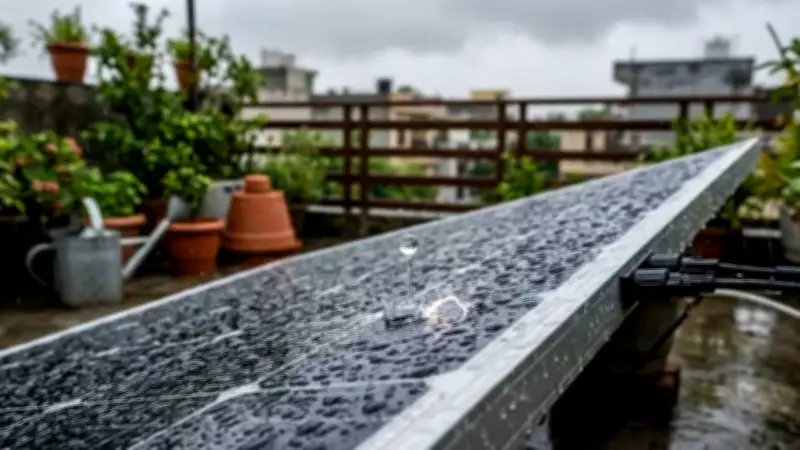
Traditionally, solar energy has been synonymous with sunny skies, but this new technology combines solar and kinetic energy harvesting to turn rainy days into productive power sources. The system integrates high-efficiency perovskite solar cells with a cutting-edge triboelectric nanogenerator. This nanogenerator captures energy from the kinetic force of falling raindrops striking a specially treated surface on the device. Through the triboelectric effect, friction between raindrops and the surface generates an electrical charge each time a drop contacts and then separates from the panel.
The device features a patented thin film, just 100 nanometers thick, which produces over 110 volts of energy from a single raindrop while simultaneously keeping the photovoltaic components dry and shielded from water damage. A study published in Nano Energy details how these devices can harvest substantial high-voltage electricity from the mechanical impact of rain, effectively transforming inclement weather into a valuable energy resource.

The Secret Behind Perovskite's Enhanced Solar Absorption
On the solar front, the hybrid system utilizes halide perovskites, synthetic materials that have recently surpassed traditional silicon in efficiency for converting sunlight into electricity. However, perovskites are notoriously sensitive to moisture, which can degrade their performance. To address this, researchers from the Spanish National Research Council (CSIC) and the University of Seville at the Institute of Materials Science of Seville (ICMS) developed a plasma-enhanced deposition technique. This method applies a protective barrier over the perovskite material, preventing water-induced degradation while also enhancing light absorption to boost overall solar conversion efficiency.
Why Hybrid Panels Are the Backbone of Autonomous Sensors
The potential applications for these hybrid panels are vast, particularly in the realm of the Internet of Things (IoT). Manufactured using scalable plasma-enhanced chemical vapor deposition (PECVD), the technology supports sustainable mass production. In smart cities, these panels could power autonomous sensors, weather stations, and auxiliary lighting systems that must operate continuously, regardless of whether the sun is shining or storms are raging. This ensures uninterrupted functionality without reliance on intermittent weather conditions.
Solving the Longevity Crisis in Remote Power Systems
According to research by the European Research Council (ERC), this hybrid technology aims to reduce dependence on traditional batteries, which often have limited lifespans and pose environmental hazards. By providing a continuous power source derived directly from the environment—through both sunlight and rainfall—these panels offer a more reliable and eco-friendly solution for remote or hard-to-access locations. Examples include marine monitoring stations and structural inspection systems on bridges, where consistent power is critical for real-time data collection and safety.
This innovation represents a pivotal step forward in renewable energy, merging multiple natural energy sources into a single, resilient system that could revolutionize how we power our world, from bustling urban centers to the most secluded outposts.