

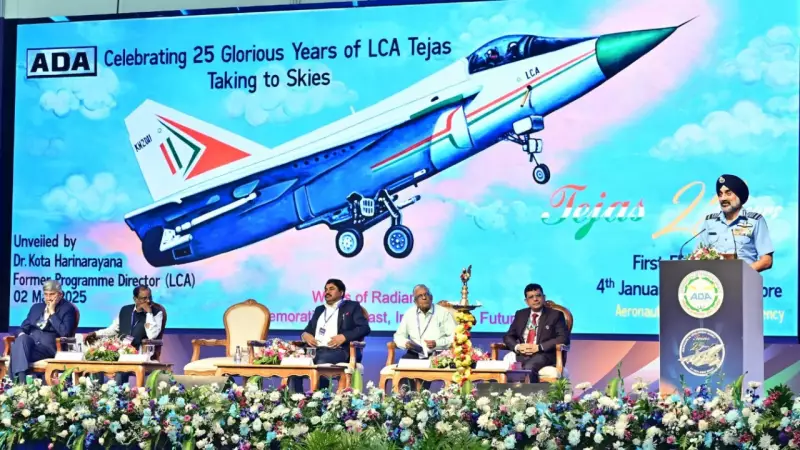
Air Chief Marshal AP Singh, the Chief of the Air Staff, delivered a strong message on the critical importance of adhering to delivery schedules for new aircraft and systems. He issued this warning during the inauguration of a national seminar in Bengaluru, even as he congratulated the Aeronautical Development Agency (ADA) on a major milestone.
Operational Readiness Depends on Timely Deliveries
The IAF chief spoke at the two-day 'Aeronautics 2047' seminar on Sunday, January 4, 2025. He emphasized that meeting committed timelines is non-negotiable. "Delays could affect IAF’s operational readiness," Singh stated. He highlighted that this is especially crucial now, as the operational environment changes quickly and the Air Force's requirements continue to expand.
The seminar itself is designed to chart the future path of Indian aviation, with a special focus on tracing the remarkable journey of the Light Combat Aircraft (LCA) Tejas. The jet has now completed 25 years since its first flight, a landmark achievement for India's domestic defence capabilities.

Tejas: From Sketch to Squadron
The story of the Tejas is one of indigenous collaboration and technological triumph. According to the Ministry of Defence (MoD), the programme involved over 100 design and development centres, including government labs, academic institutions, and private industry partners.
This massive collective effort led to breakthroughs in several niche technologies essential for modern fighter jets. These include:
- Advanced carbon composites and lightweight materials
- Sophisticated fly-by-wire flight control systems
- Digital utility management systems
- The integration of a modern glass cockpit
These innovations have enabled the Tejas to be classified as a capable fourth-generation fighter aircraft. To date, the aircraft has completed more than 5,600 successful flight trials. The IAF has already inducted 38 Tejas aircraft, which include 32 fighters and 6 trainer variants, into two operational squadrons.
The future roadmap for the programme is robust. The more advanced LCA-Mk1A variant is poised to be a key platform for the IAF. Furthermore, the LCA-Mk2 and a dedicated naval variant are currently under development, showcasing the programme's evolution.
Building a Self-Reliant Aerospace Future
ADA officials noted that the LCA programme has been instrumental in building India's domestic capacity to design and manufacture fighter jets. This theme of self-reliance was echoed by Dr. Samir V Kamat, Secretary of the Department of Defence R&D and Chairman of DRDO.
He stressed the paramount importance of developing indigenous, cutting-edge technologies to reduce dependence on foreign imports. Kamat stated that this drive for self-sufficiency "was central to achieving the vision of Viksit Bharat @2047."
The 'Aeronautics 2047' seminar served as a convergence point for experts from industry, academia, government laboratories, and the broader aerospace community. Technical discussions covered a wide array of futuristic topics, including:
- Next-generation aircraft manufacturing and digital assembly lines
- Advanced propulsion systems and aerodynamics
- The application of Artificial Intelligence in aircraft design
- Digital twin technology and new flight testing techniques
- Challenges in certification and advanced avionics
As part of the event, public sector undertakings, defence PSUs, private companies, and MSMEs exhibited indigenously designed products and systems for airborne applications, highlighting the growing ecosystem supporting India's aerospace ambitions.






