IIIT-Hyderabad's GoldAid Wearable Device Revolutionizes Industrial Safety with Real-Time Monitoring
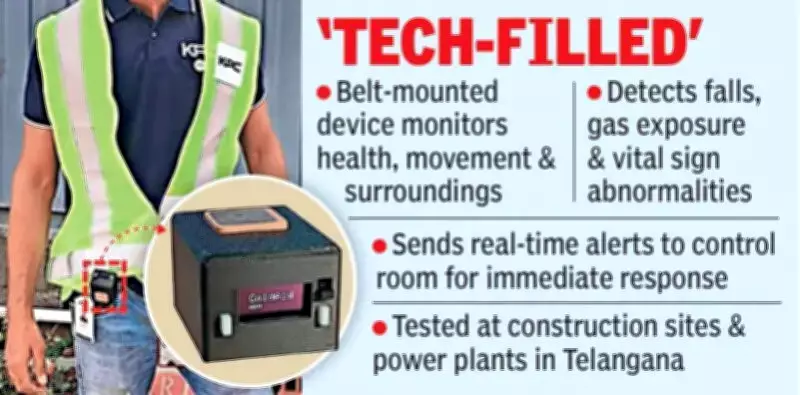
In a significant advancement for workplace safety, the International Institute of Information Technology Hyderabad (IIIT-H) has developed a wearable device named GoldAid that promises to transform safety protocols in high-risk industrial environments. This innovative system ensures that accidents are detected and reported instantly, potentially saving lives by enabling swift emergency responses.
Compact Design and Comprehensive Monitoring Capabilities
Designed by Professor Abhishek Srivastava and his team at the Centre for VLSI and Embedded Systems Technology, GoldAid is a compact, belt-mounted device worn by workers during their shifts. It continuously tracks a wide array of parameters, including movement, health metrics, and environmental conditions. The device can detect a range of risks, such as falls from heights, exposure to hazardous gases, and vital signs like heart rate, body temperature, oxygen levels, and blood pressure, Srivastava explained. If any abnormal event occurs, such as a sudden fall or signs of medical distress, the system automatically sends an alert within seconds.
Instant Alert System and Real-Time Tracking for Enhanced Response
These alerts are transmitted to a base station and then to a central monitoring system, where supervisors can track all workers in real time. An alarm is immediately triggered, facilitating a quick response and medical assistance without the delay of manual reporting. This is particularly crucial in large industrial settings like thermal power plants, oil refineries, and construction sites, where workers are often spread out and accidents can easily go unnoticed, Srivastava added. By eliminating dependence on manual reporting, the system ensures that even if a worker is unconscious or isolated, help can reach them promptly.

Preventive Features and Advanced Technology Integration
Beyond reactive measures, GoldAid also aids in accident prevention. Workers can log their baseline health levels before starting a shift, and if the system detects unusual changes, it can alert supervisors early, allowing intervention before situations escalate into dangers. Utilizing motion sensors and machine learning, the system assesses the severity of falls, distinguishing between minor slips and major accidents. Since all processing happens directly on the device, alerts are generated instantly without delays, the professor noted, highlighting the efficiency of the on-board computation.
Successful Real-World Testing and Future Implications
The system has already undergone rigorous testing in real-world environments, including a thermal power plant in Ramagundam and construction sites in Hyderabad. These trials have demonstrated its reliability and effectiveness in diverse industrial scenarios. As industries globally seek to enhance worker safety and comply with stricter regulations, innovations like GoldAid could set new standards for proactive and responsive safety management, potentially reducing accident rates and improving overall workplace well-being.