

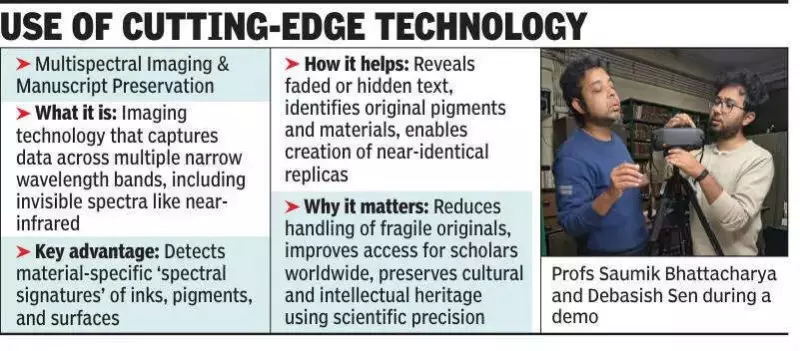
In a landmark fusion of heritage and high technology, centuries-old manuscripts at Kolkata's Asiatic Society are being saved from decay through a pioneering scientific initiative. On Thursday, a demonstration at the Society's museum revealed how cutting-edge multispectral imaging—a technique often used in space research—is being deployed to create perfect clones of irreplaceable texts that are too brittle to touch.
A New Hope for Brittle Pages
The project, conceived by the Asiatic Society, aims to tackle the inevitable deterioration of its priceless collection. Lt Col Anant Sinha, the Society's administrator, stated that this marks a crucial shift in conservation strategy. The core objective is to produce faithful reproductions, allowing scholars to study the content without repeatedly handling the fragile originals, which are written on materials like palm leaf and handmade paper using natural pigments.
Professors Saumik Bhattacharya and Debasish Sen from the Vision and Intelligence Systems wing of IIT Kharagpur conducted the demonstration. They explained that despite decades of careful preservation, age and environment have taken a toll. "These manuscripts are becoming increasingly brittle. After a point, even the best preservation methods cannot stop natural decay," Bhattacharya noted, emphasizing the urgency for creating exact clones using original materials.

How the Space-Age Technology Works
Unlike standard cameras that capture only red, green, and blue light, multispectral cameras record data across multiple, narrow wavelength bands, including near-infrared light invisible to the human eye. Each pigment and material has a unique spectral signature in how it reflects and absorbs light.
"By analysing these signatures, we can identify the precise composition of inks, pigments, and writing surfaces," said Professor Debasish Sen. "This allows us not only to replicate how a manuscript looks, but also what it is made of. We can reproduce brush strokes, pigment density, and even the frequency of strokes."
The process involves capturing multiple monochromatic images at different wavelengths, digitally aligning them, and using computational algorithms—often powered by machine learning—to reconstruct the full spectral profile of every pixel. This detailed data guide the physical recreation of the manuscript.
Beyond Preservation: Transforming Access and Research
The implications of this initiative extend far beyond simple preservation. Multispectral imaging can recover faded texts, illustrations, and material details that conventional photography misses. It opens new research possibilities, such as reading erased texts or identifying later alterations.
Furthermore, high-fidelity replicas can be safely shared with researchers across India and the globe, democratizing access to rare knowledge while the originals remain protected. The IIT Kharagpur team has already successfully replicated several ancient paintings and manuscripts, though sourcing the original stones, oxides, and vegetable dyes for pigments remains a meticulous challenge.
As the Asiatic Society scales up this project, it ensures that India's invaluable knowledge systems survive not as mere records, but as tangible, study-ready artefacts for generations to come, thanks to a rare confluence of history and innovation.






