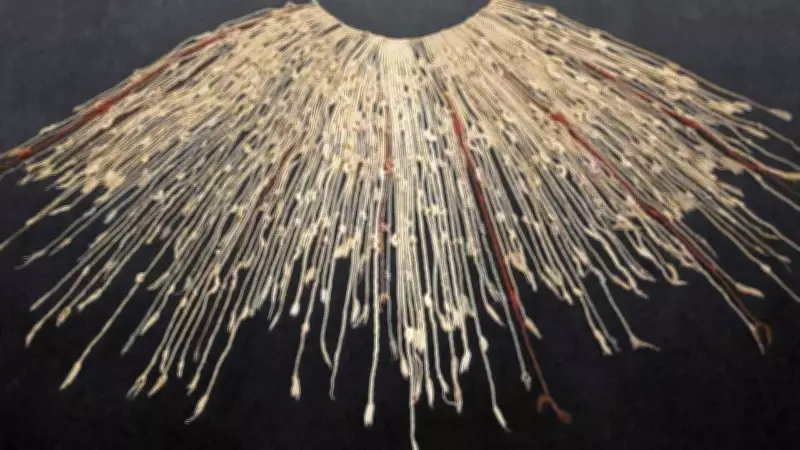
Inca Quipu System: Ancient Knot-Based Data Storage That Mirrors Modern Computing
Long before the advent of smartphones, spreadsheets, or even written alphabets as we recognize them today, the Inca civilization developed a remarkably sophisticated method for managing information across their vast empire. Known as the quipu, this system utilized knotted cords and color-coded strings to store and organize records. For decades, scholars primarily viewed quipu as a numerical tool, but recent research accepted in February 2026 suggests it was far more complex, potentially functioning as an early information technology framework.
Beyond Simple Counting: The Layered Structure of Quipu
Historically, experts like Marcia Ascher and Robert Ascher argued that quipu knots represented a decimal-based numerical system, with each knot and its position carrying specific meanings in a structured manner. However, other researchers, including Sabine Hyland, have proposed that quipus may also encode linguistic elements, such as sounds or concepts. Studies have identified up to 95 possible markers, indicating that the system's features extend beyond mere arithmetic.
The quipu's design appears layered and modular, reminiscent of how contemporary systems categorize data into groups and subgroups. It relies not just on individual knots but on the relationships between elements, creating a complexity that transforms it from a simple ledger into a comprehensive information framework.

Tree-Like Data Structures: A Computer Science Perspective
A groundbreaking perspective emerged from computer scientist Richard Dosselmann and his colleagues, Edward Doolittle and Vatika Tayal. They approached quipu not as a puzzle to decode but as a model to analyze through the lens of data structures. Their research highlights how quipu cords branch from a main cord, mirroring the tree-like hierarchies used in modern computing.
By translating these properties into programming logic with languages like C++ and Python, the team developed a file format based on quipu principles. This hierarchy allows data to be added seamlessly without extensive restructuring, and its linear scalability makes it ideal for managing layered datasets, such as census records or inventories.
Working Prototypes and Embedded Encryption
The researchers built functional prototypes inspired by quipu logic, including a spreadsheet model and an image representation tool. These modern applications demonstrate the system's adaptability and efficiency in organizing information.
One of the most intriguing aspects of quipu is its potential for data protection. According to the study, scrambling the arrangement of cords at different levels could serve as a form of embedded encryption. Unlike modern systems where encryption is applied separately, quipu's structure inherently obscures data through its organization. While the Inca likely did not intentionally design cryptographic systems, the properties of their method naturally allow for such functionality.
Quipu as an Early Information Technology
Labeling quipu as a "computer" might seem exaggerated, given the absence of electricity, processors, or binary code. However, the comparison holds merit when considering its core features. The Inca developed a structured, scalable, and adaptable method for storing and managing information, supporting hierarchy, grouping, and summarization—elements fundamental to many computing systems today.
Experts suggest it is more accurate to view quipu as an early form of information technology rather than a literal computer. It was a system built for organization and data management, not just calculation, showcasing the Inca's advanced approach to handling complex administrative tasks across their empire without a written script.