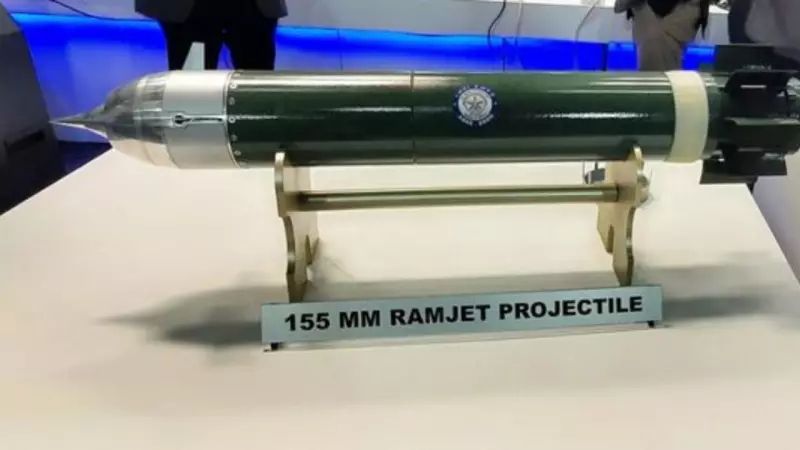
In a landmark development for indigenous defence technology, the Indian Army is poised to make military history. It is set to become the world's first armed force to operationally deploy ramjet-powered artillery shells for its formidable 155 mm gun systems. This cutting-edge advancement, born from a collaboration between the Army and academia, promises to redefine the long-range strike capabilities of conventional artillery.
A Revolutionary Leap in Propulsion
While ramjet propulsion is a known technology in the realm of missiles, its application to artillery shells is a groundbreaking innovation. Spearheaded by Professors P A Ramakrishna and S Verma from the Department of Aerospace Engineering at IIT Madras, this project has been nurtured under the Army Technology Board (ATB) as part of the Atmanirbhar Bharat initiative. After years of dedicated research, the technology is now undergoing crucial field trials.
Professor Ramakrishna explains the core principle: a ramjet is an air-breathing engine that needs no complex turbines. The shell is first launched from a standard artillery gun to a speed of approximately Mach 2. At this high velocity, air rushing into the engine is compressed automatically. Fuel is then ignited, generating continuous thrust that propels the shell forward, dramatically extending its flight range compared to a conventional, unpowered shell.

Overcoming Challenges, Delivering Performance
The research team at IIT Madras faced significant technical hurdles, primarily achieving high combustion efficiency within the extremely confined space of the shell's secondary combustor. Their success in overcoming this obstacle is detailed in their research, which highlights a key advantage: the ramjet's specific impulse (ISP) exceeds 4000 N s/kg, far superior to the ~2500 N s/kg of a standard solid rocket. This means the same amount of propellant delivers a much greater overall impulse to the shell.
The operational benefits are substantial. This indigenously developed technology is designed to increase the range of conventional 155 mm artillery shells by 30% to 50% without compromising their destructive payload. This allows the Army to engage targets at much deeper distances with enhanced effectiveness, a critical tactical advantage.
Seamless Integration and Future Deployment
A particularly cost-effective aspect of this project is its retrofitting capability. Developmental trials, including successful tests at the Pokhran field firing ranges, have proven that ramjet modules can be integrated onto the Army's existing inventory of 155 mm shells. This negates the need for designing and manufacturing entirely new ammunition from scratch.
Once the trials are complete and the technology is inducted, these advanced shells can be fired from any of the Indian Army's 155 mm artillery systems. This includes the versatile and rapidly deployable M777 ultra-light howitzers imported from the United States. This move marks a significant stride towards self-reliance in defence and positions India at the forefront of global artillery innovation.