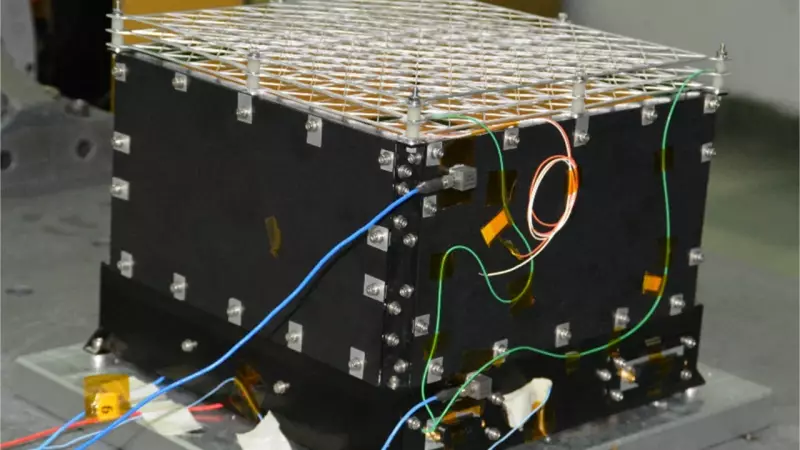
In a significant breakthrough for space science, a compact, Indian-made instrument has successfully gathered fresh evidence of the persistent rain of cosmic dust particles that continuously bombard Earth's upper atmosphere. This data is considered vital for the safety and planning of future deep-space exploration missions.
What is DEX and What Did It Find?
The instrument, named the Dust EXperiment (DEX), is the first of its kind developed indigenously to hunt for high-speed cosmic dust. It was built by scientists at the Physical Research Laboratory (PRL) in Ahmedabad. DEX hitched a ride to space aboard the PSLV Orbital Experimental Module (POEM) during the PSLV-C58 XPoSat mission launched on January 1, 2024.
After being deployed at an altitude of roughly 350 kilometres, DEX operated seamlessly from January 1 to February 9, 2024. During this period, the Indian Space Research Organisation (ISRO) confirmed that it successfully recorded multiple impact events caused by both orbital debris and genuine interplanetary dust particles. This proved its capability to identify and measure such high-velocity encounters in low-Earth orbit.

The core of DEX is a 3-kilogram dust detector that operates on the hypervelocity impact principle. Instead of trying to catch the tiny particles, which is nearly impossible at their extreme speeds, the detector is designed to 'listen' for the signal generated when a microscopic dust grain slams into it at several kilometres per second. Remarkably, this sensitive system consumes a mere 4.5 Watts of power, making it ideal for long-duration space voyages.
Steady Stream of Cosmic Particles
Orbiting with an inclination of 9.5 degrees and equipped with a wide 140-degree field of view, the detector registered a steady stream of impacts. The data showed it was being hit roughly once every thousand seconds.
From this measurement, scientists calculated the dust flux. ISRO stated that the derived flux is approximately 6.5 × 10⁻³ particles per square metre per second. This finding provides direct, recent confirmation that Earth is under constant bombardment from interplanetary debris, known scientifically as Interplanetary Dust Particles (IDPs). These IDPs are microscopic fragments shed by comets and asteroids, and their fiery plunge into the atmosphere creates the faint meteor layer and occasional 'shooting stars'.
Why This Discovery Matters for the Future
The implications of DEX's successful operation are profound and extend far beyond our planet.
For Earth's Orbit: Direct observations of IDPs help refine models of the near-Earth space environment. This knowledge is essential for assessing risks and protecting valuable satellites and space assets from damaging high-speed micro-impacts.
For Solar System Exploration: DEX serves as a proven blueprint for future detectors. Currently, there are no direct measurements of cosmic dust in the thick atmosphere of Venus or the thin veil around Mars. Instruments based on DEX's design could be sent to planets with or without atmospheres, as well as to orbit the Moon.
Accurately measuring IDP fluxes is mission-critical for exploration. Understanding the density and impact risks posed by cosmic dust is vital for planning long-term robotic missions and, more importantly, for ensuring the safety of future human expeditions to the Moon, Mars, and deeper into the solar system.
The DEX experiment marks a pivotal step for India's space technology, demonstrating the ability to build sophisticated, low-power instruments that can gather fundamental science crucial for the next era of space exploration.