

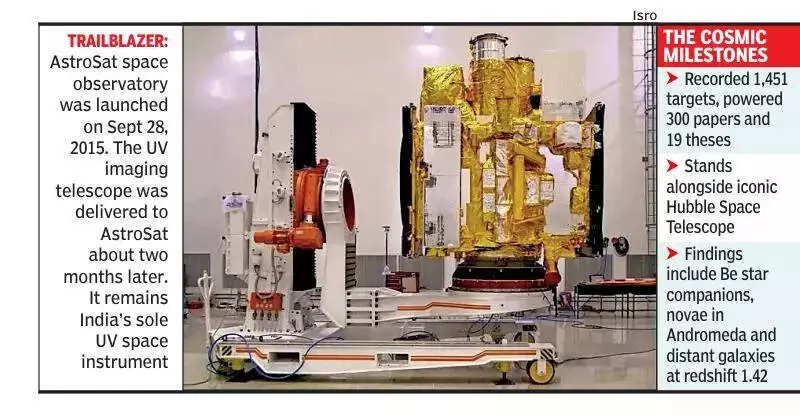
India's pioneering ultraviolet eye in the cosmos, the Ultraviolet Imaging Telescope (UVIT), has successfully completed a remarkable decade of operation. Launched aboard the country's first dedicated multi-wavelength space observatory, AstroSat, this Bengaluru-built instrument has spent ten years unveiling the universe's hidden ultraviolet secrets, invisible from the Earth's surface.
A Decade of Discovery and Data
Since opening its doors to the cosmos on November 30, 2015, UVIT has targeted an impressive 1,451 celestial objects. Its observations have been the foundation for nearly 300 research papers and have supported 19 doctoral theses, cementing its role as a vital tool for astronomers globally. The telescope, built and delivered by the Indian Institute of Astrophysics (IIA) in Hoskote, Bengaluru, remains India's sole ultraviolet space instrument and one of the world's few operational far-ultraviolet facilities, standing alongside giants like the Hubble Space Telescope.
UVIT's scientific harvest over the past ten years is profound. Key findings include:

- Discovery of hot compact companions to Be stars.
- Identification of blue straggler stars within clusters.
- Mapping extended UV discs in dwarf galaxies.
- Observing novae explosions in the Andromeda galaxy.
- Detecting UV emissions from galaxies at a high redshift of 1.42.
- Establishing connections between UV and X-ray emissions from active galactic nuclei.
Technical Prowess and Collaborative Spirit
The telescope's unique design is a key to its success. It functions as a twin system: one unit captures near-ultraviolet and visible light (200–300 nm), while the other is dedicated to the far-ultraviolet range (130–180 nm). This configuration provides a large field of view with a spatial resolution finer than 1.5 arcseconds, an advantage over earlier missions like NASA's GALEX, as noted by CS Stalin, head of the payload operations centre.
"Since UV rays are absorbed by our atmosphere, they can only be observed using space telescopes," stated Dr. Annapurni Subramaniam, Director of IIA and calibration scientist for the mission. She emphasized that the instrument's capabilities have ensured its steady use by astronomers in India and abroad.
The development of UVIT was a national endeavor, involving a consortium including the Inter-University Centre for Astronomy and Astrophysics (IUCAA) in Pune, the Tata Institute of Fundamental Research (TIFR) in Mumbai, several ISRO centres, and the Canadian Space Agency. The IIA even built special clean rooms at its CREST campus to assemble the sensitive optics.
Celebrating the Past, Planning the Future
To mark the 10th anniversary, the IIA organized a one-day academic workshop in Bengaluru. Former ISRO chairman AS Kiran Kumar, speaking at the event, recalled the pivotal contributions of the late K Kasturirangan in shaping AstroSat as a multi-institutional project. Kumar stressed the growing importance of coordination between academic institutions and private groups in building future space facilities.
"Our ability to understand the universe improves whenever we discover new ways of observing and measuring," he remarked. The legacy of UVIT is set to continue, with improved image products being uploaded to ISRO's PRADAN archive for broader access. Discussions at the workshop also revealed plans for a proposed successor mission: the Indian Spectroscopic and Imaging Space Telescope, which aims to significantly enhance the nation's capabilities in ultraviolet astronomy.
As UVIT enters its second decade, it stands as a towering testament to India's growing prowess in space science, having fundamentally expanded our view of the hot, energetic, and dynamic universe.






