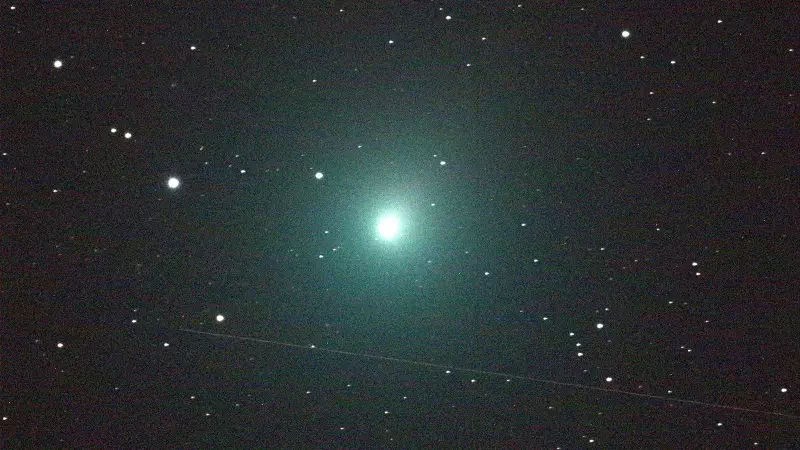
In an exciting development for space enthusiasts, the mysterious interstellar comet 3I/ATLAS has re-emerged from behind the sun, presenting astronomers with a rare opportunity to study its unique characteristics. The comet, which recently made its closest approach to our star, is displaying a brilliant green glow while curiously appearing to lack a visible tail.
The Cosmic Visitor Returns
Comet 3I/ATLAS completed its perihelion - the point of closest approach to the sun - on October 29, 2025. Following this significant celestial event, the comet became visible again in early November, allowing researchers to conduct detailed observations of this rare interstellar traveler. On Wednesday, November 5, researcher Qicheng Zhang from the Lowell Observatory in Arizona captured new images using the facility's Discovery Telescope, marking an important milestone in tracking this cosmic visitor's journey through our solar system.
The comet, first discovered in July 2025, has generated substantial scientific interest as only the third confirmed interstellar object to visit our solar system. Astronomers believe it originated from a distant, unidentified stellar system within the Milky Way, potentially making it up to three billion years older than our own solar system. While some have playfully speculated about extraterrestrial origins, the scientific community remains focused on understanding its actual composition and behavior.

Unraveling the Green Glow Mystery
The distinctive green coloration of comet 3I/ATLAS comes from an interesting chemical process involving diatomic carbon (C₂). Zhang employed specialized filters to detect this molecule, which is responsible for the comet's striking appearance. "The comet contains many large hydrocarbons - molecules made of hydrogen and carbon - which break apart when exposed to ultraviolet light from the sun," Zhang explained to Live Science.
He provided a relatable analogy: "It's similar to how our skin gets sunburned when we stay in the sun too long without protection. The UV radiation damages our DNA, which, like these hydrocarbons, consists of large carbon-based molecules." When this process occurs on the comet, the resulting diatomic carbon - composed of two bonded carbon atoms - emits the characteristic green glow that makes 3I/ATLAS so visually striking through astronomical instruments.
The Case of the Disappearing Tail
Recent observations have revealed another intriguing aspect of 3I/ATLAS: the apparent absence of a dust tail. Instead, the comet displays asymmetric brightness that appears stronger on its left side. According to Zhang, this isn't cause for concern but rather an optical illusion. The tail does exist but lies directly behind the comet, slightly curved to the left, creating a head-on perspective that makes it difficult to observe from Earth's viewpoint.
This unusual configuration hasn't dampened scientific enthusiasm. In fact, it provides additional clues about the comet's composition and history. Preliminary data suggests that 3I/ATLAS may have developed a thick, irradiated outer crust from prolonged exposure to cosmic radiation during its interstellar journey. This means the material currently being released might represent altered surface compounds rather than pristine samples from its original star system.
Post-Perihelion Discoveries and Future Observations
The period following perihelion represents peak activity for most comets, as solar radiation heats their icy cores, causing frozen material to sublimate into gas and dust that forms a diffuse atmosphere called a coma. On October 31, Zhang conducted the first optical observations of 3I/ATLAS after its close solar encounter, capturing the comet at dawn as it drifted northward from the northeastern horizon.
Earlier findings published on arXiv on October 28 documented a rapid brightening of the comet before perihelion and noted its noticeably blue hue relative to the sun. Zhang's analysis confirmed that this blue appearance corresponds to shorter wavelengths of light, with the comet appearing significantly brighter through blue-green filters that capture these wavelengths most effectively.

The comet's changing position in the sky now makes it accessible to more observers. While initially only large telescopes like the Lowell Discovery Telescope could study 3I/ATLAS immediately after perihelion, its rising trajectory means many observatories - and even skilled amateur astronomers using 6-inch (15 cm) telescopes - can now track its continuing journey into the depths of space.
As 3I/ATLAS continues its departure from our solar system, each observation provides valuable insights into the composition and behavior of objects from distant stellar systems, helping scientists better understand the diversity of materials traveling between stars in our galaxy.