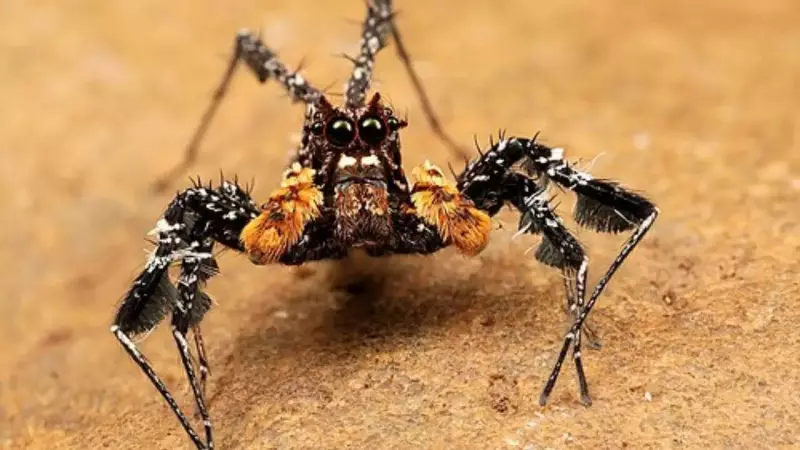
For decades, spiders were largely viewed as simple creatures that only reacted to immediate stimuli, like a fly hitting their web. However, research over the last twenty years has dramatically reshaped this understanding, revealing surprising cognitive abilities in some species. A standout example is the Portia spider, a genus of jumping spiders whose sophisticated hunting strategies include planning, deception, and the remarkable ability to pursue prey it can no longer see.
The Master Hunter: Portia Spider's Appearance and Habitat
The spider at the centre of this fascinating research is Portia, a member of the Salticidae family, commonly known as jumping spiders. These are small predators, with a body length typically under 15 millimetres. Their appearance is deliberately unkempt; their bodies are angular, mottled with irregular colours and covered in hairs. This clever disguise helps them blend seamlessly into backgrounds like tree bark, leaf litter, and the debris of other spiders' webs.
Portia species are found across Africa, Asia, and Australasia, inhabiting forests, woodland edges, and even gardens. They are specialist predators of other spiders and do not build typical capture webs. Instead, they live as invaders near the webs of other spiders or patrol vegetation where potential spider prey resides. Their movements are famously slow and deliberate, punctuated by long pauses, making them stealthy hunters that avoid detection.

A Complex Hunting Strategy: Beyond Simple Vision
Portia's primary diet consists of other spiders, including orb-weavers and tangle-web spiders. The hunt begins with a patient visual scan from a distance. When targeting a web-dwelling spider, Portia employs a tactic of deception: it enters the web and plucks the silk strands in patterns that mimic a trapped insect or a courting male. This lures the resident spider closer. Portia can even adjust its plucking rhythm based on the prey's response.
While its large, forward-facing principal eyes provide excellent vision for initial assessment, Portia's hunting prowess relies on more than sight. Its secondary eyes detect peripheral movement, and its legs are equipped with sensitive receptors called slit sensilla. These detect minute vibrations and strains in the silk or substrate. Furthermore, fine hairs on its legs pick up airborne vibrations. This suite of senses allows Portia to track prey even when it is visually obscured.
Memory in Action: Tracking Hidden Prey
Controlled laboratory experiments, documented in publications like Frontiers in Psychology, have proven Portia's ability to use short-term memory. In these tests, a spider would view prey from a platform, then take a detour where the prey was hidden from sight for up to a minute. Researchers found that Portia retained a 'mental map' of the prey's location and number.
Upon reaching a new vantage point, if the prey scene had changed (e.g., a prey item was removed), the spider would hesitate, alter its path, or abandon the hunt. If the scene matched its memory, it proceeded confidently. This shows Portia does not simply reset when visual contact is lost but acts on stored information, a cognitive feat placing it among a select group of invertebrates.
The Role of Vibration and Evolutionary Adaptation
When vision fails, vibration becomes Portia's guiding sense. By analysing the frequency and direction of vibrations through its legs, it can pinpoint a prey spider's location within a complex web. It carefully adjusts its posture and steps to refine this information, pausing often to let sensory data accumulate. This allows for precise, stealthy advancement even in complete visual obscurity.
This unique combination of vision, vibration sensing, and short-term memory is a product of evolution shaped by its niche. Living in visually cluttered environments among webs and dense vegetation made the ability to hunt without constant line-of-sight a major advantage. Specialising in hunting other dangerous spiders also favoured patience, tactical deception, and the capacity to plan routes based on past information over brute speed.

The story of the Portia spider challenges old assumptions about the limits of the arthropod mind. It demonstrates that complex, flexible hunting strategies involving memory and planning are not exclusive to vertebrates. This small but formidable predator continues to provide profound insights into the evolution of animal cognition.