

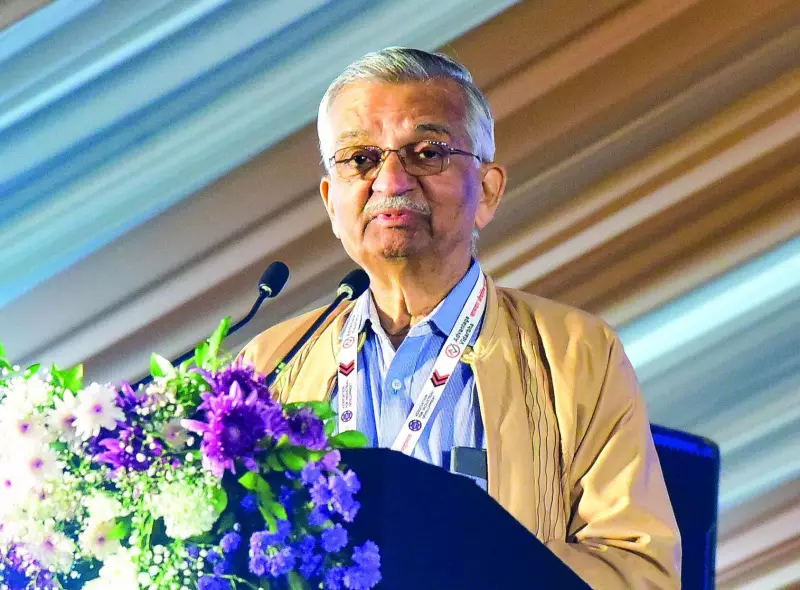
As India continues its economic ascent, a leading scientist has issued a crucial warning: the nation must actively prevent the gap between the rich and the poor from widening. This call for equitable growth came from eminent nuclear physicist and former chairman of the Atomic Energy Commission, Dr. Anil Kakodkar.
A Development Model That Checks Disparity
Speaking at the 7th edition of the Manohar Parrikar Vidnyan Mahotsav in Panaji on Thursday, Kakodkar identified disparity as a primary source of long-term instability. He argued that India's development framework must inherently include mechanisms to keep inequality in check. "As a country advances and economic progress moves forward, so does the disparity," he stated, highlighting a critical challenge of progress.
The physicist emphasized that the solution lies in creating applications and systems that bridge the divide. This means connecting the 'haves' and 'have-nots,' and ensuring access to knowledge and facilities for all. "One good way of doing that is to pay attention to the villages," Kakodkar advised, pointing to rural India as a focal point for inclusive development.

Science with Excellence and National Impact
Addressing students, Kakodkar outlined a dual vision for Indian science. First, it must achieve global excellence, create new knowledge, and pioneer technologies. Secondly, and with equal importance, science must tackle India's core problems. "We should be able to understand the core problems facing our country and resolve them through science and technology," he said.
He championed the concept of India-specific development in science and technology, asserting that tailored solutions are what will propel the nation forward at a faster pace. Illustrating a modern path, he cited the example of Zoho Corporation's CEO, Sridhar Vembu, who moved his global headquarters from the United States to a Tamil Nadu village. Kakodkar suggested that in the era of remote work, contributing to the economy from a village is a viable and impactful model.
Celebrating Science and Youth: The Mahotsav's Success
The event itself stood as a testament to fostering scientific temper among the youth. Jose Manuel Noronha, chairperson of the celebration committee, revealed that the Manohar Parrikar Vidnyan Mahotsav has engaged over 30,000 students in the past six years.
Goa Chief Minister Pramod Sawant highlighted the scale of the current festival, noting that 19 scientists are delivering lectures simultaneously at eight different venues, a unique feat in the country. The festival also honored Dr. Sai Gautam Gopalakrishnan, an associate professor at the Indian Institute of Science, Bengaluru, with the Manohar Parrikar Yuva Scientist Award for his work in computational materials science.
Adding to the inspirational discourse, former ISRO chairman A S Kiran Kumar recounted India's giant leaps in space since 1969. He filled the young audience with anticipation, declaring, "In a few years, you will see Indians going around the earth in our own launch vehicles."
Kakodkar concluded by remembering former Goa CM Manohar Parrikar, noting that science and young people were central to his vision for the state. The messages from the mahotsav collectively underscored a roadmap for India: pursue growth, but ensure it lifts every village and citizen, using science as the great equalizer.






