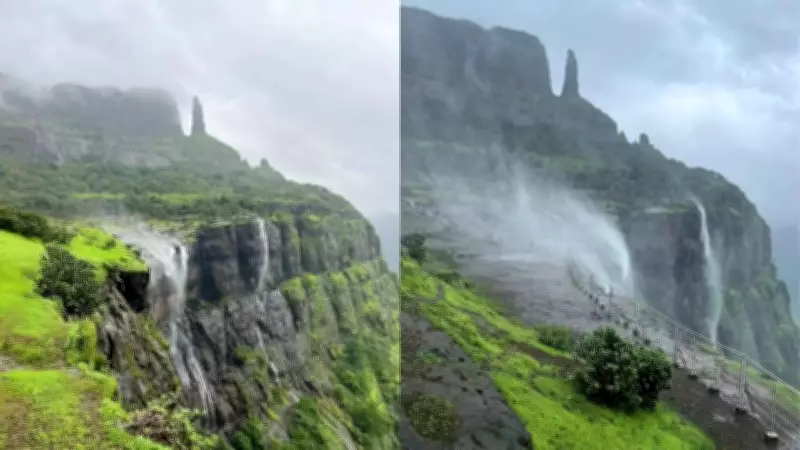
Monsoon in Maharashtra brings about spectacular changes in its geography. The hills become covered in greenery, seasonal streams flow, and waterfalls emerge within the Western Ghats. One of the most amazing monsoon attractions that appears to defy the laws of nature is the Reverse Waterfall at Naneghat.
What is a Reverse Waterfall?
Despite its name, a reverse waterfall is not a waterfall flowing upward from its source. It is a natural phenomenon caused by powerful winds. During peak monsoon activity, rainwater cascades down the vertical cliffs of Naneghat as usual. However, due to strong winds blowing upward through the mountain pass, the falling water gets lifted back into the atmosphere. From a distance, it gives the impression that the water is moving upstream. This fleeting process depends entirely on climatic factors such as wind velocity, rainfall levels, and the geographical nature of the pass. On certain days, the effect is pronounced; other times, visitors only see a fine spray of water lifting into the air.
Why Naneghat is Uniquely Suited
Naneghat sits in a gap within the Western Ghats, a mountain range known for its distinct climatic conditions. The pass acts as a natural corridor through which strong monsoon winds travel from the Arabian Sea toward the Deccan region. As these winds strike the high cliffs of Naneghat, they blow upward at a faster pace. Combined with heavy rains during certain seasons, this creates the conditions suitable for the reverse waterfall effect. Although reverse waterfalls occur in some other areas within the Western Ghats, Naneghat has gained recognition as one of the most accessible places in Maharashtra to witness this phenomenon.

More Than a Waterfall
The mountain pass has been a significant trading route for merchants traveling from the rich ports on the Konkan coast to the interior areas. It is home to rock-cut caves and inscriptions dating back to the Satavahana dynasty. A pot-like stone structure near the caves traditionally served as a toll collection point for merchants. The name "Naneghat" is often interpreted as deriving from the words nane (coins) and ghat (mountain pass), reflecting its historical role. For travelers interested in combining nature with heritage, Naneghat offers both in a single visit.
Best Time to Visit
The reverse waterfall is a strictly seasonal attraction. The chances of witnessing the phenomenon are highest in July and August due to heavy precipitation and strong winds. However, weather is always uncertain, and there is no assurance that the reverse effect will occur each time.
Monsoon Travel Tips
The weather that produces the reverse waterfall can also make navigating the area difficult. Rocks around viewing points are often slippery, and the weather becomes hazy and foggy during rain. Sudden gusts of wind can be unpredictable. Visitors should wear non-slippery shoes and avoid going too near cliffs. It is also recommended to travel early morning, as it rains harder later in the day.
Getting to Naneghat
By Road: Naneghat is about 120 km from Mumbai and 120-130 km from Pune. The usual route is through Junnar town in Pune district. Private vehicles or taxis are the easiest mode of transportation, especially during monsoon rains.
By Train: The nearest railway stations are Kalyan Junction and Pune Junction, from where taxis or local transport can be taken to Junnar and then to Naneghat base village.
By Air: Nearby airports include Pune Airport and Chhatrapati Shivaji Maharaj International Airport in Mumbai. Both cities provide road connections to Naneghat.
Trekking Route: Naneghat is a popular trekking destination. The usual route passes through the Konkan village of Vaishakhare, following the ancient trade route to the Naneghat summit. This moderate trek is especially enjoyable during the monsoon, though care is needed due to slippery paths.