

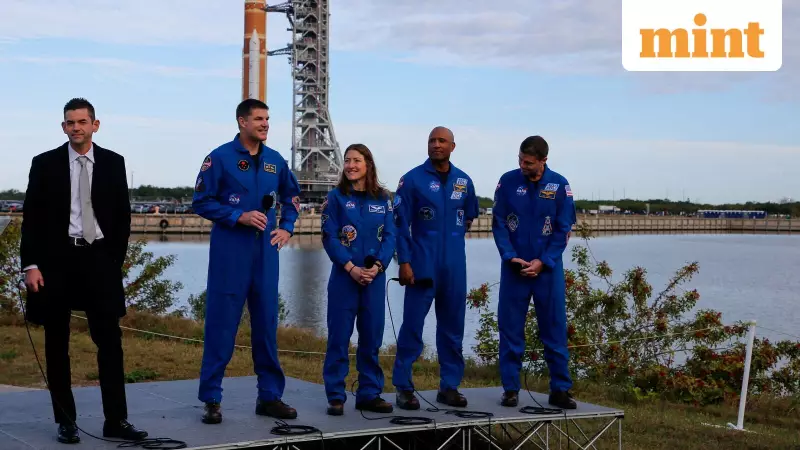
NASA's powerful Space Launch System rocket and Orion spacecraft are preparing for a major move this Saturday. The massive vehicle will travel from the Vehicle Assembly Building to a launchpad at Kennedy Space Center in Florida. This rollout marks the start of an ambitious journey that could rewrite space exploration history.
Historic Crew Prepares for Lunar Journey
The Artemis II mission could launch as early as February 6th on a ten-day voyage around the moon. This will be humanity's first return to lunar vicinity since Apollo 17 completed its mission in 1972. Four astronauts will make this groundbreaking trip: NASA's Reid Wiseman, Victor Glover, and Christina Koch, along with Jeremy Hansen from the Canadian Space Agency.
This diverse crew represents several historic firsts. The mission will mark the initial journey beyond low-Earth orbit for a person of color, a woman, and a Canadian astronaut. Their spacecraft will travel beyond the far side of the moon, venturing into deep space.

Why Artemis II Won't Land on the Moon
Despite approaching close to the lunar surface, the astronauts will not actually land. Patty Casas Horn, NASA's deputy lead for Mission Analysis, provides a straightforward explanation. "The short answer is because it doesn't have the capability. This is not a lunar lander," she told CNN.
The Orion capsule will carry the crew around the moon after the SLS rocket launches it into Earth orbit. NASA has clear priorities for this mission according to Horn. Crew safety and health come first, followed by vehicle safety, with mission objectives like testing navigation and propulsion systems coming afterward.
Potential to Break Distance Records
Artemis II could potentially surpass Apollo 13's longstanding distance record. That mission reached 248,655 miles from Earth in 1970. While Artemis I already traveled beyond that distance without crew in 2022, Artemis II might achieve this milestone with astronauts aboard.
"It depends on when we fly. The trajectory is constantly changing because it is optimized for the best propulsion usage," Horn explained. NASA currently has launch windows stretching from February 6th through April 30th, 2026.
The mission will begin with two revolutions around Earth before initiating the translunar injection maneuver approximately 26 hours into flight. This critical procedure will propel the spacecraft out of Earth orbit and toward the moon.
Simplified Mission Approach
By avoiding lunar orbit insertion, NASA simplifies the mission complexity. This approach allows astronauts to concentrate on essential tasks without piloting responsibilities. The crew can focus on system checks, observations, and maintaining their spacecraft during the historic journey.
NASA's careful planning emphasizes safety while pursuing ambitious exploration goals. The upcoming rollout represents a visible step toward returning humans to lunar space after more than five decades.






