

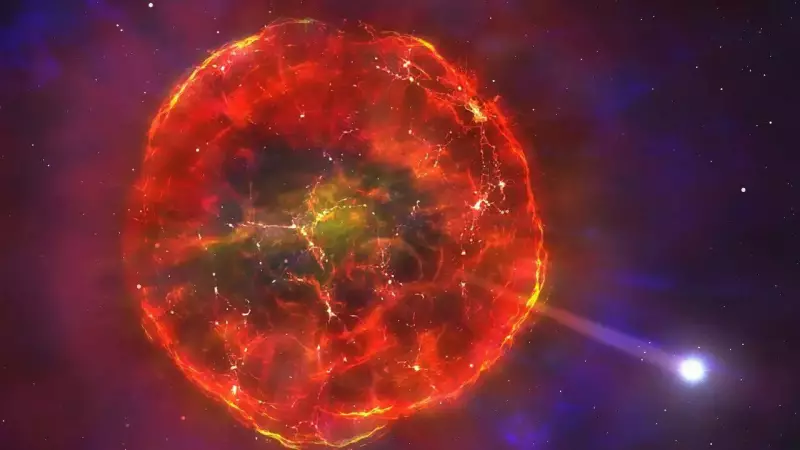
In a groundbreaking revelation that has sent shockwaves through the global astronomical community, NASA has uncovered a mysterious red celestial object racing through our Milky Way galaxy at an extraordinary velocity that defies conventional understanding. The enigmatic sphere, officially named CWISE J1249, is presenting astronomers with a cosmic puzzle that challenges fundamental theories about the formation and behavior of stars and planets.
The Extraordinary Discovery
The remarkable detection was made possible through NASA's Wide-field Infrared Survey Explorer (WISE) telescope, specifically designed to identify faint, distant, and cold objects in space using infrared light technology. What initially appeared as an unusually bright point in the telescope's observations quickly revealed itself to be something far more extraordinary when motion data was analyzed.
Unlike conventional rogue planets that drift slowly through the cosmic void, CWISE J1249 travels at an astonishing speed of over one million miles per hour, immediately capturing the attention of NASA researchers and astronomers worldwide. This velocity places it among the fastest isolated celestial objects ever recorded in astronomical history.

Unprecedented Characteristics
Detailed spectroscopic analysis has uncovered a set of remarkable features that make CWISE J1249 virtually impossible to classify using existing astronomical categories:
- Extremely low mass, far below the threshold of typical stars
- Minimal metal content, indicating an unusual or primitive composition
- Unique infrared signature unlike any known stars, planets, or substellar objects
- Spherical red structure indicating heat emission and gravitational cohesion
- Complete independence, not orbiting any star and moving freely through the galaxy
The WISE telescope's infrared capabilities confirmed that CWISE J1249 is not merely space debris or a rock fragment, but a structured body with internal energy. Its distinctive red coloration suggests heat emission, yet it lacks the brightness characteristic of conventional stars.
Cosmic Speed Demon
To fully appreciate the incredible velocity of CWISE J1249, consider these comparative speed measurements:
- Earth orbits the Sun at approximately 67,000 miles per hour
- Fast-moving stars typically travel between 200,000 and 500,000 miles per hour
- The Milky Way galaxy itself rotates at around 515,000 miles per hour
- CWISE J1249 surpasses all these at over 1,000,000 miles per hour
This extraordinary speed implies that the object was propelled by a tremendous force, either gravitational or explosive in nature, setting it apart from virtually all other known objects in our galaxy.
Scientific Investigation and Theories
Astronomers are currently exploring two primary theories to explain the origin and nature of this cosmic mystery. One hypothesis suggests that CWISE J1249 could be a fragment of a white dwarf supernova, ejected at extreme velocity during the explosive death of its parent star. This scenario would account for its minimal metal content and incredible speed.
The alternative theory proposes that it might be a failed star or an ejected planet, never fully ignited or expelled from its original system by intense gravitational interactions, possibly involving encounters with binary stars or black holes.
However, neither theory completely explains all the observed characteristics, leaving the true nature of this red sphere shrouded in mystery and prompting intense global scientific investigation.
Broader Scientific Implications
The discovery of CWISE J1249 holds profound significance for our understanding of the cosmos. Rogue planets and isolated stellar remnants provide critical insights into gravitational dynamics, planetary system instability, and the effects of ancient cosmic explosions.

If confirmed as a supernova remnant, this object could reveal how stellar explosions influence surrounding objects and contribute to galactic architecture. Its unusual characteristics suggest it may belong to an ancient population of objects formed under conditions vastly different from those seen in today's universe, potentially representing a primordial cosmic artifact.
The global astronomical community continues to study CWISE J1249, recognizing that this mysterious red sphere might fundamentally alter our understanding of celestial formation and evolution, opening new chapters in humanity's quest to comprehend the mysteries of our galaxy.





