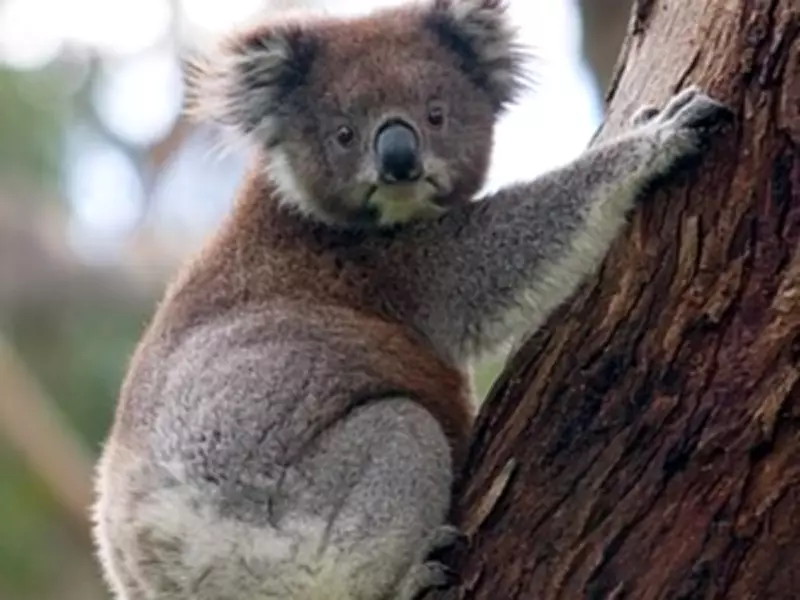
For over a century, the story of the Australian koala seemed straightforward: a fluffy, eucalyptus-eating icon of the eastern states. However, a recent discovery in Western Australia has rewritten this narrative entirely. While the koalas we know today thrived on the eastern side of Australia, a secret relative lived a completely different existence in the forests and caves of the west.
Discovery of a Unique Skull
The Western Australian Museum was the first to receive a remarkable donation: a koala skull originally discovered in Moondyne Cave by caver Lindsay Hatcher. For years, the specimen waited to be studied. When researchers finally examined it closely, they noticed something unusual—deep, round dimples on the cheeks. This feature, described as a 'thumbprint,' belonged to an animal that scientists had overlooked for over a century.
Hidden in Plain Sight
For a long time, experts assumed that koala fossils found in Western Australia were simply members of the existing species, Phascolarctos cinereus. This assumption seemed reasonable, given the superficial similarity of many marsupial fossils to untrained eyes. However, a team of researchers decided to test this hypothesis using comparative anatomy. Their findings, published in the journal Royal Society Open Science, revealed that these fossils were not our familiar koalas. The researchers officially named the new species Phascolarctos maxillaris, derived from 'sulco' (groove) and 'maxillaris' (cheekbone), referring to its most distinguishing characteristic.

Distinctive Anatomy
The prehistoric Western Australian koala was not merely an 'embellished' cousin of its eastern counterpart. This species had a smaller, stronger skull with broader teeth. While its skull was more robust, its limbs were thinner and longer. The slender and agile body shape contrasts sharply with the stockier, rounder koalas seen in today's sanctuaries. The unique cheekbone grooves are a key identifier of this ancient marsupial.
Why the Cheekbone Matters
It might seem strange that a small groove on a cheekbone could be so important. However, in biology, form always follows function. The cheek is where the muscles that control the nose and lips attach in koalas. Researchers believe that the deep grooves of Phascolarctos maxillaris indicate more powerful and larger facial muscles. This would have given the ancient koala a more flexible upper lip, allowing it to manipulate leaves and select shoots with precision. The enhanced dexterity, combined with a potentially improved sense of smell due to greater nostril movement, suggests an expert forager finely tuned to the environment of the ancient Margaret River region.
A Warning from the Past
To understand the fate of this rare creature, the research team returned to its source. They trekked through narrow, dusty passages in Koala Cave at Yanchep and Foundation Cave near Margaret River. Using radiocarbon and uranium-thorium dating, they pinpointed the exact time of the species' disappearance. It is likely that the 'dimpled koala' went extinct around 28,000 years ago. This date coincides with a period when Australia's climate was drastically drier and colder. Ancient pollen records show that the lush eucalyptus forests of the south-west shrank dramatically during this time.
Koalas are known for being fussy eaters, and their forests are integral to their biology. When the trees vanished, the Western Australian koala was left with nowhere to live. This discovery serves as a stark reminder of how vulnerable these animals are to habitat loss. As we confront modern climate change and deforestation, the story of Phascolarctos maxillaris provides a historical blueprint of what happens to a specialist species when its habitat disappears.
A Richer Koala History
The research adds another branch to Australia's koala family tree, but it also shows that Australia once had a wider range of koalas. From the Pleistocene 'giant koala' that was twice the size of modern koalas to the slender, dimpled West Coast specialist, the history of this iconic animal is far more complex than previously imagined.