

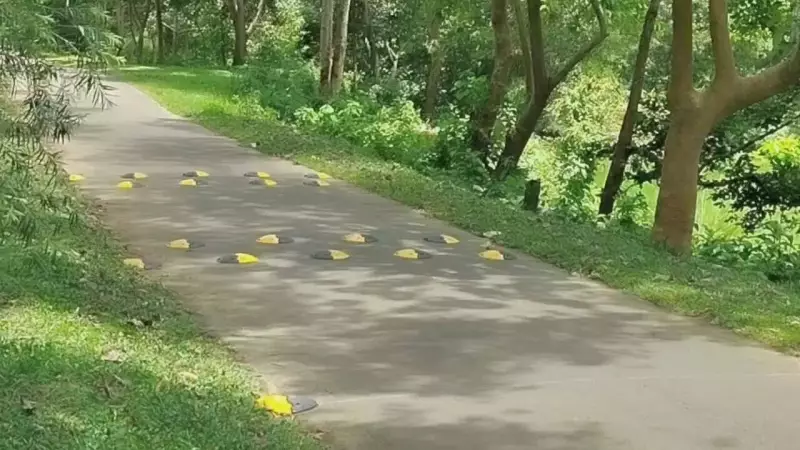
In a significant development for road infrastructure, a collaborative research team from the National Institute of Technology (NIT) Silchar and Nirma University, Ahmedabad, has engineered a novel alternative to conventional speed bumps. This innovation aims to tackle the perennial problem of rider discomfort while effectively ensuring vehicles slow down in sensitive zones.
The Problem with Traditional Speed Breakers
Traditional speed bumps, though effective for speed reduction, are notorious for causing significant jolts and vibrations. These can lead to discomfort, potential injuries, and long-term health impacts for daily commuters and professionals like cab and freight drivers. The abrupt deceleration also affects vehicle longevity and can damage transported goods.
Introducing the Spherical Cap Studs (SCS) Solution
The research project, funded by the Department of Science and Technology (DST) at NIT Silchar, resulted in the creation of Spherical Cap Studs (SCS). Designed to offer a gradual slowing mechanism, the SCS provides a markedly smoother ride experience compared to its jarring predecessors.

The study specifically evaluated SCS for two-wheelers, a dominant mode of transport in India. Guided by Assistant Professor Dr. Suprava Jena of NIT Silchar and Assistant Professor Dr. Manish Dutta of Nirma University, BTech students from both institutions conducted practical tests. They used motorised two-wheelers and the Phyphox Android application to collect precise data on speed and vibration.
Research Findings: Safety Meets Comfort
The team employed an experimental approach, developing speed profiles for vehicles passing over both SCS and standard bumps. Using the Mean Absolute Percentage Difference (MAPD) for comparison, they confirmed that SCS possesses comparable speed reduction capabilities to traditional bumps.
The breakthrough was in comfort metrics. Researchers calculated the Vibration Dose Value (VDV) and Static Compressive Stress (Se). The analysis revealed a 12.8% reduction in VDV and a substantial 45.57% reduction in Se when using SCS. This data conclusively indicates a major decrease in physical discomfort for riders.
The research paper concludes that SCS could effectively replace traditional speed bumps, especially in areas like marketplaces, residential neighbourhoods, and educational campuses where balancing safety with commuter comfort is crucial.
This indigenous innovation promises to make urban commutes safer and less strenuous, addressing a common civic grievance with a scientific, user-centric solution.






