In a pioneering move that blends infrastructure development with environmental conservation, the Ministry of Road Transport and Highways (MoRTH) and the National Highways Authority of India (NHAI) have unveiled a groundbreaking safety-focused highway design. This initiative, implemented on a critical stretch in Madhya Pradesh, demonstrates a successful model for protecting both wildlife and motorists as India's road network expands.
India's First Red Highway: A Visual Speed Breaker
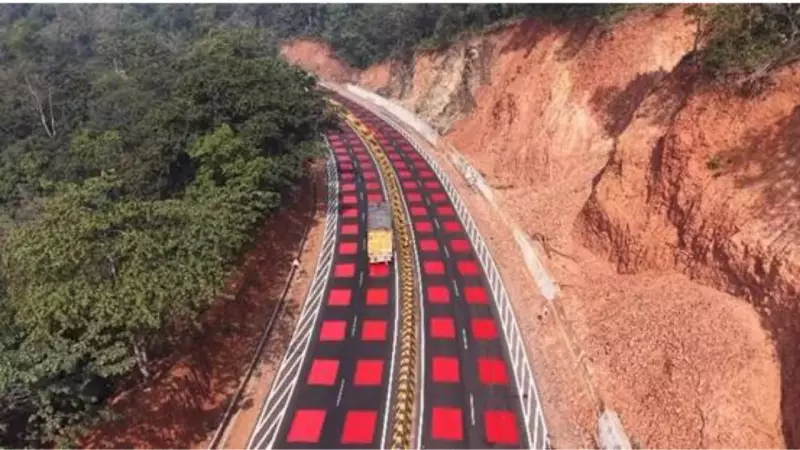
The centrepiece of this project is the introduction of the country's first-ever 'table-top red marking' on a National Highway. Inspired by global examples like Dubai's Sheikh Zayed Road, the NHAI has applied a distinctive 5 mm thermoplastic red coating on the carriageway within designated danger zones. This vibrant red surface acts as an immediate visual cue for drivers, signalling their entry into a speed-controlled and ecologically sensitive area.
The innovation lies in its subtle yet effective design. The coating provides a delicate tactile input through slightly elevated roughness, naturally prompting drivers to reduce speed without the discomfort or sudden jolt associated with traditional rumble strips. To further enhance safety on this forested stretch, white shoulder lines have been painted along the road margins, guiding vehicles and preventing them from straying onto unpaved areas.

Engineering for Ecology: Underpasses and Solar Lights
The red marking is just one part of a comprehensive, ecology-first safety plan implemented along an 11.96 km highway section, which includes a challenging 2.0 km ghat portion cutting through the Veerangana Durgavati Tiger Reserve (formerly the Nauradehi Sanctuary). Recognising the area's fragile ecology and frequent wildlife movement, the NHAI has constructed 25 strategically placed animal underpasses.
These underpasses are carefully aligned with natural ground contours and drainage lines to encourage animals to use them for safe passage. Complementing this, a continuous chain-link fencing runs along both sides of the road, effectively preventing animals from directly entering the carriageway. For monitoring, cameras have been installed on minor bridges that also serve as crossing points.
Emphasising minimal ecological disturbance, the project uses solar-powered lights at bridges, junctions, and culverts, making night driving safer without harming the environment. The entire surface treatment requires no alteration to the existing road structure or drainage, produces less noise than conventional methods, and can be easily modified in the future.
A Blueprint for Coexistence
This experiment in Madhya Pradesh proves that engineering, ecology, and safety can successfully co-exist. By marrying global design standards with local ecological knowledge, the NHAI has created a safer, wildlife-sensitive corridor. The model ensures the smooth flow of vehicular traffic while actively shifting gears towards conservation efforts.
The project highlights a significant shift in how infrastructure is built in biodiverse zones. It sets a precedent, demonstrating that with thoughtful innovation, India's growing highway network can be developed without compromising the safety of its precious wildlife or its citizens.