The Fascinating Phenomenon of Aviation 'Time Travel'
In the realm of aviation, a curious phenomenon occurs where an aircraft appears to fly "before it takes off." This is not a glitch in the space-time continuum but a regular occurrence resulting from trans-Pacific flights crossing the International Date Line (IDL) between Japan and California. According to the National Oceanic and Atmospheric Administration (NOAA), when a flight travels east from Japan to California and crosses the 180-degree meridian, the calendar must be reset backward by a full day.
The International Date Line: Resetting the Calendar in the Pacific
The 'time travel' effect is created by the International Date Line, an imaginary boundary at 180 degrees longitude in the Pacific Ocean that separates two consecutive calendar days. NOAA defines this line as a crucial marker for global timekeeping. When a commercial airliner crosses the IDL eastward from Japan toward California, it gains a day in travel. To synchronize with the world calendar, the plane's local calendar and clock system are adjusted backward by 24 hours, allowing passengers to experience the same date twice.
For example, if a flight departs Japan on a Saturday and crosses the IDL, it arrives in California on Friday, creating a chronological loop that feels like traveling back in time. This adjustment is a human-made convention to maintain a consistent 24-hour day on our spherical Earth, which rotates every 24 hours.

How the SR-71 Blackbird Outpaced Earth's Rotation
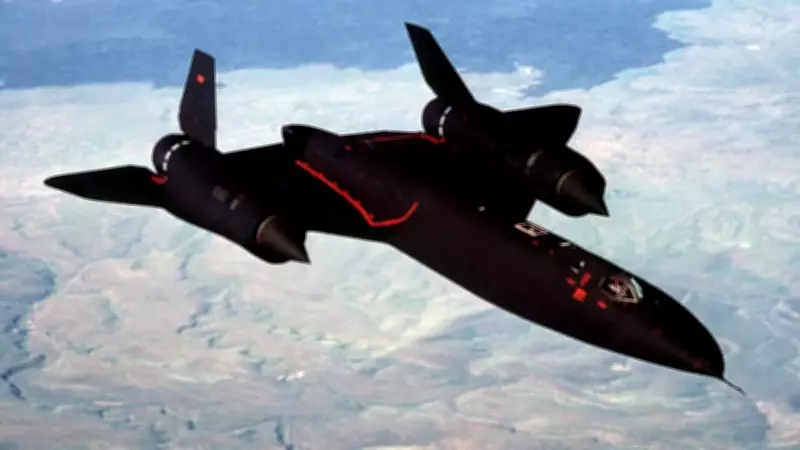
While all commercial airlines experience this calendar shift, the most extreme examples of 'time travel' were recorded by the legendary SR-71 Blackbird aircraft. Capable of speeds exceeding 2,100 mph (Mach 3.2), the SR-71 could outpace the full rotation of the Earth. NASA flight data reveals that pilots leaving Okinawa, Japan, on a Saturday morning could fly so rapidly that they arrived at Beale Air Force Base in California on Friday afternoon, prior to their departure time.
This high-speed capability allowed the SR-71 to literally outrun sunlight across the horizon, turning a theoretical quirk into a tangible reality. The aircraft's ability to 'gain' a day while arriving at its destination on the previous day showcases the intersection of advanced engineering and geographic principles.
Chronological Paradox vs. Physical Time Travel
This phenomenon highlights a key distinction between science fiction time travel paradoxes and physical sciences. When someone travels a large distance and experiences a time shift due to the IDL, their calendar indicates a change, but their biological clock continues to run forward. As noted in theoretical physics journals, this type of time travel violation aligns with Einstein's Theory of Relativity as an artificial, human-made convention for measuring time.
It remains a fascinating result of our need to coordinate time across a rotating planet, emphasizing that while we can manipulate calendars, our physical experience of time remains constant. This aviation quirk continues to captivate scientists and travelers alike, blending geography, physics, and human innovation.