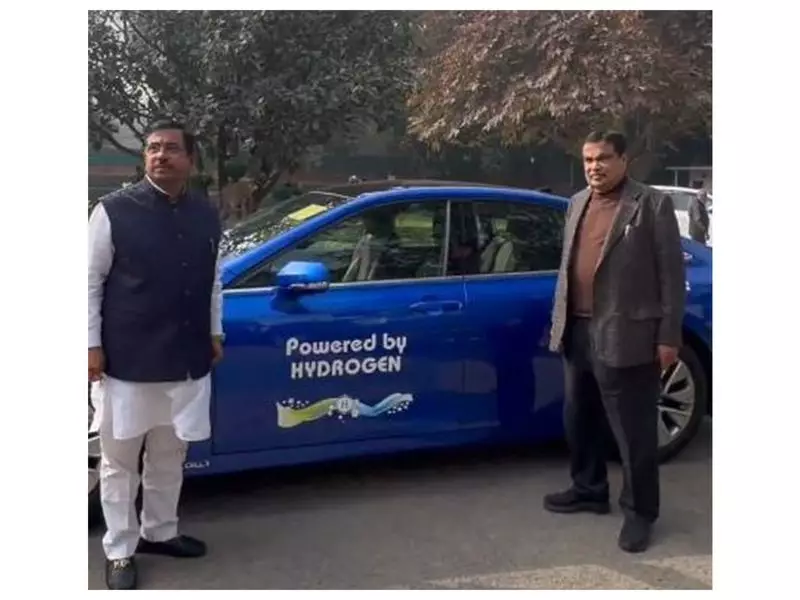
In a significant move to promote clean energy alternatives, Union Minister for Parliamentary Affairs, Coal, and Mines, Pralhad Joshi, personally took the wheel of a hydrogen-powered car in the national capital. The demonstration drive, held in New Delhi, served as a powerful endorsement of hydrogen fuel cell technology as a viable and eco-friendly solution for India's future mobility needs.
Minister's Hands-On Endorsement for Green Hydrogen
The minister test-drove a Toyota Mirai, a vehicle powered by a hydrogen fuel cell. During the event, Joshi emphasized the critical role green hydrogen is expected to play in India's energy transition. He highlighted that this initiative aligns perfectly with the National Green Hydrogen Mission, a flagship program launched by the Government of India with an ambitious outlay of Rs 19,744 crore.
"This is the future," stated Minister Joshi, expressing his confidence in the technology. He underscored the government's commitment, led by Prime Minister Narendra Modi, to developing a robust green hydrogen ecosystem. The drive was not merely symbolic; it was a clear signal to industry stakeholders and the public about the seriousness with which India is pursuing this cutting-edge, zero-emission technology.

How Hydrogen Fuel Cell Technology Works
Unlike conventional electric vehicles that rely on large battery packs, hydrogen fuel cell vehicles generate electricity on-board through a chemical reaction between hydrogen and oxygen. The only emission from this process is water vapor, making it an exceptionally clean source of power. The Toyota Mirai, used in the demonstration, is a prime example of this technology, offering a long driving range and quick refueling times comparable to petrol or diesel vehicles.
Minister Joshi pointed out the advantages of hydrogen, particularly for long-haul transportation and heavy industries, where battery-electric solutions may face challenges. The government's mission aims to make India a global hub for the production, usage, and export of green hydrogen and its derivatives.
Strategic Push Under the National Green Hydrogen Mission
The public demonstration by a senior Union Minister brings much-needed visibility and momentum to the green hydrogen sector. The National Green Hydrogen Mission has set aggressive targets, including the production of 5 million metric tonnes of green hydrogen per annum by 2030. This is expected to not only reduce India's dependence on fossil fuel imports but also position the country as a leader in the global clean energy arena.
The event signifies a multi-ministerial push, as the development of green hydrogen spans across sectors like power, transportation, fertilizer, and refining. By personally driving the car, Minister Joshi, who holds crucial portfolios in coal and mines, bridges the narrative between traditional energy sources and the clean energy future.
The key expected outcomes of this mission include:
- Decarbonization of major economic sectors.
- Development of indigenous manufacturing capabilities.
- Creation of export opportunities for green hydrogen and related technologies.
- Generation of significant investment and job opportunities.
The Road Ahead for Hydrogen Mobility in India
While the technology is promising, experts acknowledge that challenges such as establishing a widespread hydrogen refueling infrastructure and reducing production costs remain. However, demonstrations like the one led by Minister Joshi are vital for building public awareness and investor confidence. They showcase the government's proactive approach in embracing and piloting new technologies that can drive sustainable growth.
This hands-on advocacy by a senior minister sends a strong message to automakers, energy companies, and research institutions to accelerate innovation and collaboration in the hydrogen value chain. As India strides towards its net-zero commitments, green hydrogen, symbolized by initiatives like this test drive, is poised to be a cornerstone of the nation's energy security and environmental strategy.