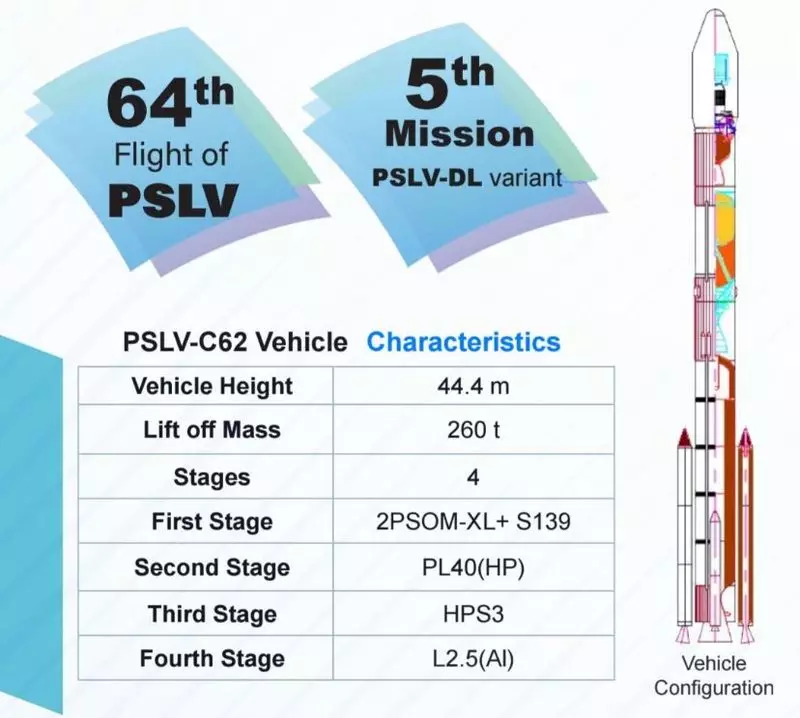
The Indian Space Research Organisation (ISRO) has initiated the final countdown for a landmark mission, marking a significant start to the new year for India's space program. The countdown for the launch of the Polar Satellite Launch Vehicle (PSLV) in its C62 configuration commenced at 8:10 AM on Sunday, December 31, 2023. This sets the stage for the vehicle's lift-off scheduled for Monday, January 1, 2024, at 9:10 AM from the Satish Dhawan Space Centre (SDSC) SHAR in Sriharikota.
Mission Objectives and Payload Details
The primary objective of the PSLV-C62 mission is to place the X-ray Polarimeter Satellite (XPoSat) into a precise low Earth orbit. XPoSat represents a major leap for Indian space science as it is the country's first dedicated scientific satellite designed to study the polarization of cosmic X-rays. This sophisticated observatory will investigate the dynamics of bright astronomical X-ray sources under extreme conditions, offering new insights into celestial phenomena like neutron stars and black hole regions.
The mission will utilize the trusted workhorse of ISRO, the PSLV rocket, in its Core Alone configuration. This means the launch vehicle will fly without its standard solid strap-on boosters, relying solely on its core stages. The launch window is precisely timed for 9:10 AM on New Year's Day, with the 25-hour and 10-minute countdown proceeding smoothly as per the pre-launch schedule.

Pre-Launch Preparations and Significance
All pre-launch checks and propellant filling operations for the four-stage rocket are being carried out meticulously at the First Launch Pad of SDSC SHAR. The XPoSat spacecraft has been successfully integrated with the launch vehicle, and final system checks are underway. This mission underscores ISRO's growing prowess in space-based astronomy and its commitment to fundamental scientific research.
The launch of XPoSat positions India among a select group of nations capable of conducting advanced X-ray polarimetry from space. The data gathered by the satellite's two primary payloads – POLIX (Polarimeter Instrument in X-rays) and XSPECT (X-ray Spectroscopy and Timing) – is expected to provide a deeper understanding of radiation processes and geometries near cosmic sources.
What This Means for India's Space Ambitions
This mission is a clear indicator of ISRO's balanced focus between application-oriented projects for national development and pure science missions that expand human knowledge. Following the resounding success of the Chandrayaan-3 Moon landing and the Aditya-L1 solar mission, the XPoSat launch reinforces India's position as a serious player in global space exploration and astrophysics.
The choice of New Year's Day for the launch adds a symbolic touch, representing a fresh beginning and ambitious trajectory for India's space endeavors in 2024. Space enthusiasts and scientists across the country and the world will be watching as the PSLV-C62 soars from the Sriharikota coast, carrying India's first dedicated X-ray polarimetry observatory to its intended orbit.