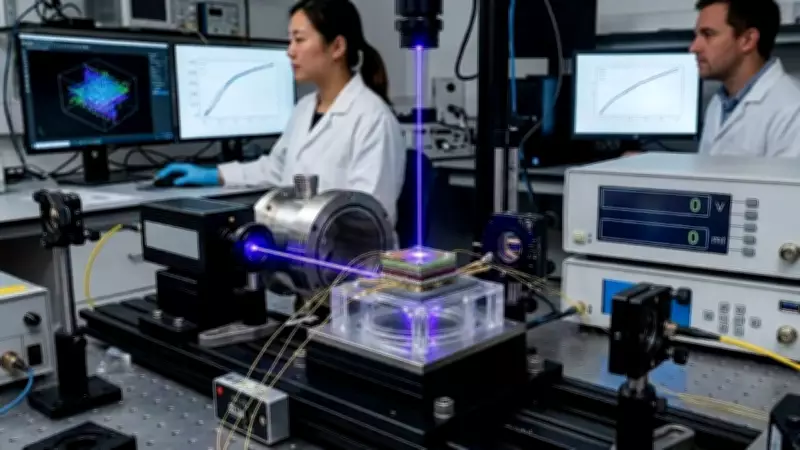
Quantum Battery Breakthrough: Australian Team Builds Prototype Using Light
In a landmark achievement, researchers from the CSIRO, RMIT University, and the University of Melbourne have successfully transitioned quantum battery theory into a practical prototype. This development bridges the gap between energy science and physics, paving the way for advanced energy storage technologies that could transform how we power devices and vehicles.
How Quantum Mechanics Replaces Chemical Reactions
Unlike traditional electrochemical batteries that depend on chemical reactions for energy storage, this innovative organic battery harnesses the principles of quantum mechanics. Specifically, it utilizes superposition and light-matter interactions to store energy. This approach eliminates the reliance on ion movement, which often limits the speed and efficiency of conventional batteries.
Superextensive Charging and Overcoming Degradation
One of the defining features of this quantum battery is superextensive charging, where the battery charges faster as its size increases. This characteristic directly addresses a common issue in traditional batteries: degradation and slower charging rates as they scale up. The prototype operates at room temperature, enabling near-instantaneous charging and facilitating long-distance wireless power transfer through the use of lasers.

Research Published in Nature: Proof-of-Concept Device
The findings, detailed in a study published in the journal Nature, describe a proof-of-concept device constructed from a multi-layered organic semiconductor. Researchers employed a microcavity to trap photons, creating conditions that leverage quantum 'co-operative' effects for charging. This method allows the battery to charge significantly faster than its chemical counterparts by bypassing the physical constraints of ion transport.
Beyond Linear Limits: Ending the Charging Bottleneck
A pivotal discovery from this research is that quantum batteries are not bound by the linear rules of classical physics. In traditional systems, adding more cells typically slows down the charging process and complicates it. However, in the quantum battery prototype, the 'co-operative' nature of molecules means that additional qubits work together to enhance energy absorption rates, a phenomenon termed superabsorption.
Organic Materials Enable Room-Temperature Quantum States
Historically, maintaining quantum states required subzero temperatures, but this breakthrough leverages organic materials to achieve stability at room temperature. The researchers used a distributed Bragg reflector, a type of high-reflection mirror, to optimize light-matter interactions. This ensures that energy is stored efficiently with minimal risk of becoming incoherent, making the technology more practical for everyday applications.
Powering the Next Generation of Electric Vehicles
According to the CSIRO, the ultimate goal of this research is to scale the technology for consumer use, particularly in powering electric vehicles (EVs). Beyond charging via electromagnetic radiation such as light or lasers, the technology enables over-the-air charging. This could allow EVs and handheld devices to be powered remotely without the need for physical connections to the grid, revolutionizing energy accessibility and convenience.
This quantum battery prototype represents a significant step forward in energy technology, with potential implications for sustainability, efficiency, and the future of transportation and electronics.