

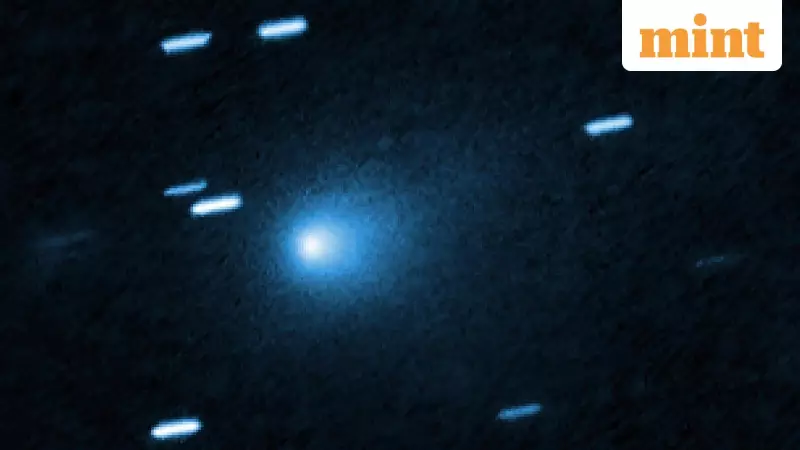
A celestial spectacle of immense scientific importance is unfolding tonight, 19 December, as the rare interstellar comet 3I/ATLAS makes its closest approach to our planet. This mysterious visitor, which journeyed from a star system far beyond our Sun, has captivated astronomers across the globe, including those at major Indian observatories.
A Rare Messenger from Deep Space
Comet 3I/ATLAS is only the third confirmed interstellar object ever detected by humanity. It follows the now-famous 1I/‘Oumuamua, spotted in 2017, and comet 2I/Borisov, discovered in 2019. This latest visitor was first identified on 1 July by NASA-funded ATLAS telescopes operating in Chile. Scientists quickly determined its extraordinary origin by calculating its high speed and unique trajectory, which conclusively proved it did not originate in our own solar system.
Despite the headline-grabbing close approach, there is absolutely no cause for alarm. The European Space Agency has confirmed the comet will maintain a very safe distance. It will come no closer than approximately 1.8 astronomical units (AU) from Earth. To put that in perspective, one AU is the average distance between Earth and the Sun. This means the comet will be nearly twice that far away, or about 168 million miles (270 million kilometres). Experts have unequivocally stated it poses zero danger to Earth or any other planet as it journeys through our inner solar system.

Why This Flyby is a Golden Opportunity for Science
Although distant, tonight's passage is a priceless event for the global scientific community. It provides a fleeting window to study the composition of a true interstellar traveler. As 3I/ATLAS nears the Sun, its icy nucleus heats up, releasing dust and gas into a glowing coma and tail. By analyzing this material with powerful telescopes, researchers can gather clues about how comets form around other stars.
This data acts as a direct comparison to the building blocks of our own solar system. In essence, objects like 3I/ATLAS are cosmic messengers, delivering tangible samples of chemistry and physical processes from realms far outside our own. Major agencies like NASA and ESA have directed instruments, including the Hubble Space Telescope and the JUICE Jupiter probe, to capture new images and data of the fast-moving object in recent weeks.
How to Watch the Historic Celestial Event Live
For skywatchers in India and around the world eager to witness this historic flyby, the event will be accessible online. Astronomer Gianluca Masi will host a free livestream through the Virtual Telescope Project. The broadcast is scheduled to begin at 4 am UTC on 20 December, weather conditions permitting. This translates to 9:30 AM Indian Standard Time (IST) on Thursday morning. Once it completes its swing around the Sun, 3I/ATLAS will continue on its boundless path, eventually leaving our solar system forever, making this observation opportunity truly once-in-a-lifetime.
FAQs at a Glance:
What exactly is interstellar comet 3I/ATLAS?
It is an extremely rare comet that originated in a star system other than our own. It is only the third such interstellar visitor ever confirmed by scientists.
Is this comet a threat to Earth?
No. It will pass at a perfectly safe distance of about 168 million miles, which is nearly double the Earth-Sun distance.
How can I watch it from India?
Tune into the free online livestream provided by the Virtual Telescope Project, starting at 9:30 AM IST on 20 December.






