Historic Gemini 8 Photographs Reveal Astronauts' Post-Emergency Condition
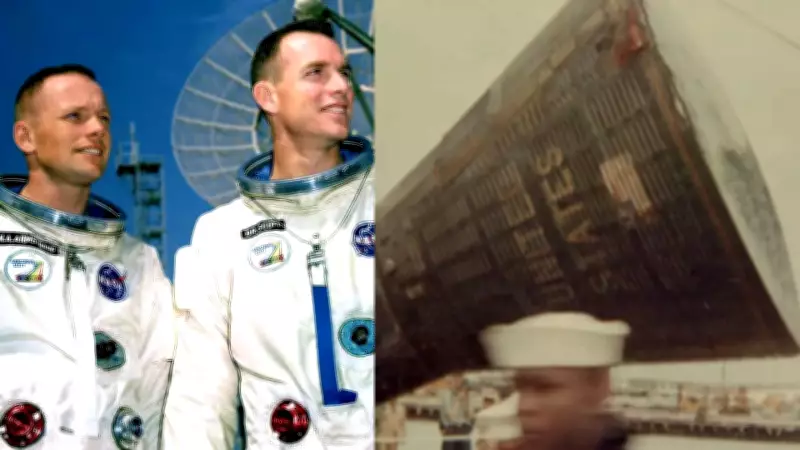
Newly released photographs from NASA's Gemini 8 mission provide a rare visual record of astronauts Neil Armstrong and David Scott immediately following their emergency return to Earth in 1966. The images, which were reportedly taken by Army veteran Ron McQueeney, have been donated to the Armstrong Air & Space Museum in Wapakoneta, Ohio, by McQueeney's widow.
Mission Cut Short by Critical Spacecraft Malfunction
The Gemini 8 mission launched on March 16, 1966, and achieved the first successful docking of two spacecraft in orbit. However, the mission took a dramatic turn when the docked vehicles began to spin uncontrollably, reportedly completing one full revolution per second. Armstrong activated the spacecraft's thrusters to stabilize the dangerous spin, using fuel that had been reserved for the remainder of the mission.
Both astronauts were at serious risk of losing consciousness due to the rapid rotation, making Armstrong's quick response crucial to their survival. The mission was terminated approximately 10 hours after launch, with the spacecraft splashing down near Okinawa, Japan.

Recovery Operations Documented in Rare Images
The photographs capture Armstrong and Scott on the deck of the USS Leonard F. Mason, the US Navy ship that recovered them from the Pacific Ocean. Additional images show the astronauts at Naha Air Base in Okinawa, Japan, where they were transported following their recovery.
The visual record includes Gemini 8 being lifted for transport after splashdown, as well as Armstrong and Scott walking through a crowd of US service members. McQueeney was specifically called to document the astronauts immediately after their recovery, creating one of the few visual records of their post-mission condition following the near-disastrous in-orbit incident.
Historical Significance of the Mission and Photographs
The Gemini 8 mission is regarded as a critical test of orbital docking procedures and astronaut performance under emergency conditions. Armstrong's response to the uncontrolled spin is frequently cited as evidence of his composure and technical skill, qualities that contributed significantly to his selection for the Apollo 11 mission in 1969.
Historians note that the mission's success in safely returning the crew despite the malfunction provided valuable data for future manned space missions. Armstrong and Scott's ability to manage fuel reserves and stabilize the spacecraft under emergency conditions directly informed NASA's protocols for subsequent Gemini and Apollo missions.
Museum Display and Historical Preservation
The Armstrong Air & Space Museum plans to display the photographs as part of its permanent collection. Museum executive director Dante Centuori stated that the images provide a clear record of the mission and the astronauts' recovery process, while also serving as a historical record of US naval support operations in post-mission recovery.
Few media outlets attended the recovery event at the time, as the early mission termination was unplanned, making these photographs particularly valuable for historical documentation. The images offer a unique glimpse into a critical moment in space exploration history, capturing the immediate aftermath of what could have been a catastrophic space incident.