

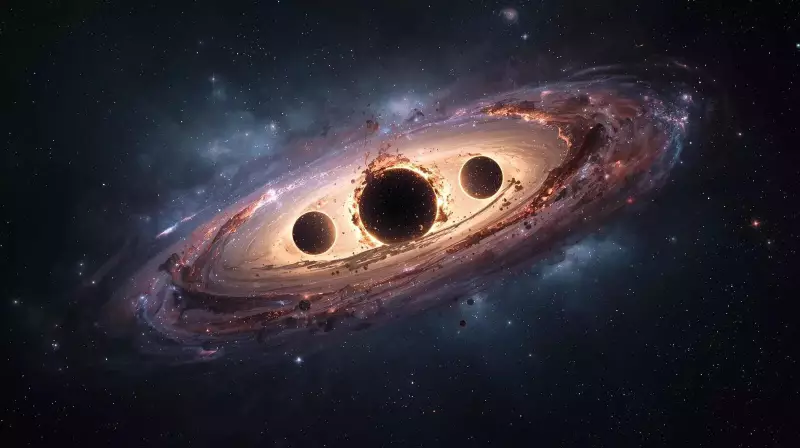
In a remarkable cosmic discovery, astronomers have confirmed the existence of a rare and spectacular system: three supermassive black holes, all actively feeding, at the centres of three galaxies that are in the process of merging. This finding, which provides a tangible example of a phenomenon previously confined mostly to theoretical models, was reported in a study published in The Astrophysical Journal Letters.
A Cosmic Trio Defying Coincidence
The discovery began when scientists were reviewing radio data from deep space and noticed something unusual. Three bright radio signals appeared suspiciously close together. Initial thoughts of a mere coincidence were quickly dismissed. Each powerful signal was traced back to the core of a distinct galaxy. Further analysis revealed that all three galaxies were gravitationally interacting, locked in a cosmic dance of merger.
The consistent and groundbreaking result was that each galaxy hosts a supermassive black hole, and crucially, all three black holes are active. This means they are actively pulling in surrounding gas and dust, a process that heats the material and causes it to emit strong radio waves. While triple systems have been theorized, observing one in the midst of a galactic merger is exceptionally rare.

Why This Discovery Stands Out
Most large galaxies, including our Milky Way, harbour a single supermassive black hole at their centre. When two galaxies collide and merge, it can result in a binary black hole system, which astronomers have observed before. However, a system with three active black holes is a different league altogether.
It requires a very specific and uncommon scenario where three galaxies come together in the same region at roughly the same time. The odds become even slimmer when all three central black holes are actively accreting material during this interaction. This makes the newly discovered system a precious natural laboratory for studying complex gravitational interactions and the dynamics of multiple black holes competing for fuel.
The Role of Radio Waves in the Detection
The detection of this triple threat hinged on radio astronomy. Active black holes often produce high-energy jets and outflows that emit strong radio waves. These radio signals can travel vast cosmic distances and, importantly, penetrate through the thick clouds of dust that typically shroud the chaotic centres of merging galaxies.
In this case, astronomers were able to pinpoint three separate, powerful radio sources clustered together. Each radio source aligned perfectly with the nucleus of one of the three interacting galaxies, confirming the presence of the active black holes. Follow-up analysis solidified the initial observations.
Implications and Future Research
This discovery does not overturn existing theories but adds a crucial and exciting data point. It confirms that such complex triple systems can and do exist in nature. The ongoing galaxy merger is likely the key driver, as it funnels vast amounts of gas and stellar material toward the galactic centres, simultaneously feeding all three black holes and switching them into an active state.
The future of such a system is uncertain. The black holes may eventually spiral inward and merge in a colossal gravitational wave event, or one may become dominant and eject the others. There is no clear timeline for these events. Now that one such system has been conclusively identified, astronomers are motivated to search for more, helping to determine just how common or rare these cosmic trios truly are.






