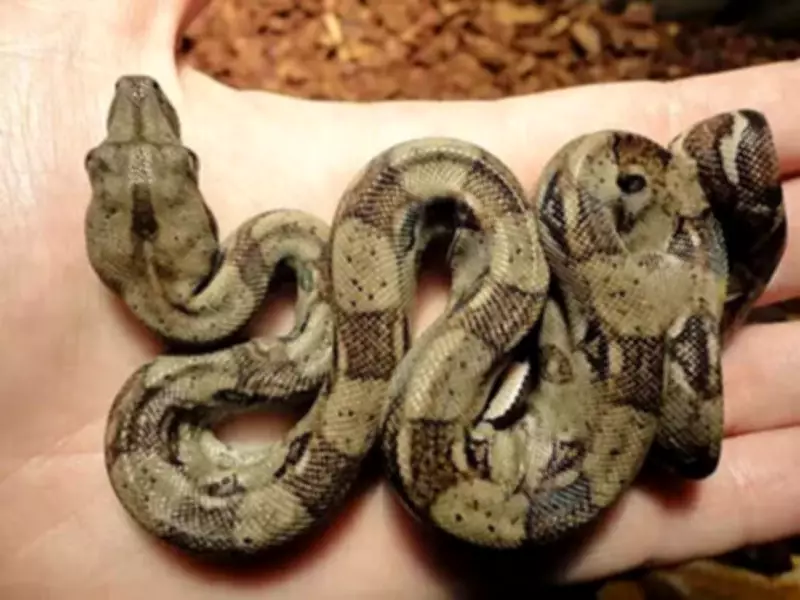
People often assume that all snakes move with serpentine locomotion, using S-shaped movements to propel themselves. However, this is not true for every snake species. A fascinating alternative is rectilinear locomotion, a straight-line crawling method used by heavy-bodied snakes such as boas, pythons, and vipers. This form of movement allows snakes to advance without curving their bodies sideways, relying instead on specialized belly scales, muscular action, and friction control.
What Is Rectilinear Locomotion in Snakes?
Rectilinear locomotion, also termed linear progression, involves the snake moving in a straight line rather than in loops or curves. During this motion, the snake holds its body upright and moves slowly. According to an article titled 'Snakes mimic earthworms: propulsion using rectilinear travelling waves,' this movement is achieved through "sequential lifting, anchoring, and pushing against individual ventral scales." This type of locomotion is commonly observed in heavier snakes like boas and pythons, which have large belly scales that act as anchors when their ribs move in waves within the skin. The process resembles caterpillar locomotion, involving creeping movements. Rectilinear locomotion is ideal for snakes that need to move silently and gradually, as it causes minimal disturbance and helps them avoid detection by predators.
Why Do Some Snakes Move in a Straight Line?
The linear locomotion of snakes is primarily linked to their size and predatory habits. Larger snakes are often too bulky to use fast serpentine movements while stalking prey. Research indicates that rectilinear locomotion enables them to move with minimal energy consumption. By keeping the belly in constant contact with the ground, snakes gain stability as they advance. Their ventral scales function as tiny gripping pads, and studies have shown that these scales produce different levels of friction depending on direction, allowing snakes to progress without limbs.

Snake Muscles and Scales as the Means of Locomotion
The secret behind this unique movement lies beneath the snake's skin. Snakes have hundreds of ribs connected to well-developed muscles. During rectilinear movement, these muscles contract in a wavy pattern. The muscles, attached to several ribs at an angle, activate the movement of a belly scale. Through contraction and relaxation, the scales slide upward while pulling backward, pushing the body forward. This complex process requires precise coordination. Biologists studying snake locomotion consider it one of the most interesting examples of limbless movement in nature, and it has inspired the design of snake robots.
Snakes Use More Than One Type of Movement
Not all snakes rely solely on rectilinear locomotion. Almost all snakes can switch between different types of movement depending on their environment. The four main recognized types are: serpentine locomotion (the standard slithering form), rectilinear locomotion (straight-line crawling), concertina locomotion (an accordion-like climb), and sidewinding (used on loose sand). Sidewinding is typical of desert snakes, while rectilinear locomotion is common in large snakes. In 2021, researchers discovered a novel form called "lasso locomotion" in brown tree snakes climbing vertical posts. As one researcher noted, "This wasn't something a snake was supposed to be able to do." Snakes continue to surprise scientists with their mechanical ingenuity.