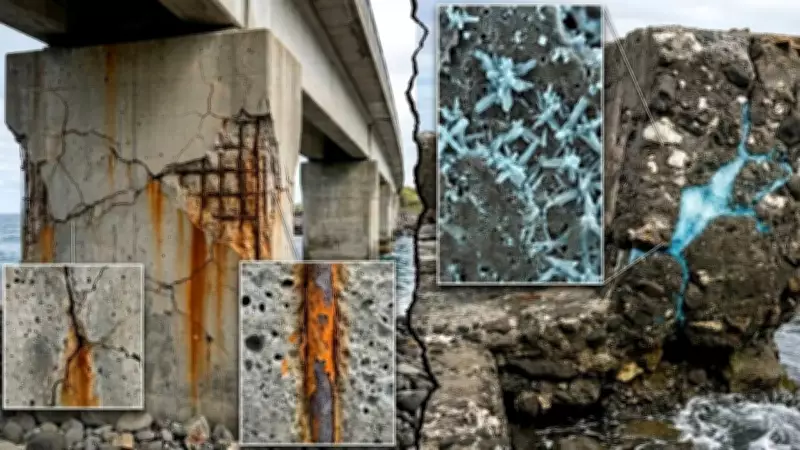
Ancient Roman Concrete's Self-Healing Secret Outlasts Modern Skyscrapers
While modern skyscrapers and bridges may begin deteriorating within 50 years, ancient Roman structures like the Pantheon and coastal seawalls have stood strong for over 2,000 years. For decades, engineers mistakenly believed white mineral fragments in Roman mortar resulted from improper mixing. However, groundbreaking research from MIT and Harvard has uncovered the truth: these lime clasts were intentionally used to create hybrid cements with remarkable self-healing properties.
The Self-Healing Mechanism of Roman Concrete
When cracks form in Roman concrete structures, mineral-rich water dissolves some of the embedded lime clasts. The dissolved minerals then recrystallize over three to six months, effectively gluing the cracks back together. This autonomous repair process allows ancient Roman piers and temples to withstand seismic activity and harsh environmental conditions, enabling them to last indefinitely compared to contemporary concrete buildings.
Modern concrete lacks this flexible chemical composition, relying instead on steel rebar for structural integrity. While steel provides tensile strength, it creates a critical vulnerability: when water penetrates hairline cracks and reaches the rebar, oxidation occurs. The expanding iron creates internal stress, leading to spalling and structural failure—a "cancer-like" degradation absent in Roman designs.

Why Roman Temples Outlast Modern Construction
Research published in Science Advances identifies lime clasts as the defining feature of Roman longevity. Cracks in Roman walls inevitably travel through these brittle lime clasts. When water from rain or seawater enters these cracks, it reacts with calcium hydroxide, forming a calcium-saturated solution. This solution recrystallizes into calcium carbonate, sealing cracks and preventing further damage.
The primary ingredients of Roman concrete—volcanic ash (pozzolan) and quicklime—create a chemically active mixture that strengthens over millennia. In contrast, modern cement mixtures lack these reactive components, making them prone to rapid deterioration.
Maritime Marvel: Concrete That Grows Stronger with Seawater
For maritime construction, Romans harnessed the reaction between seawater and volcanic ash. While seawater typically degrades modern concrete, in Roman structures it triggers a pozzolanic reaction that produces aluminous-tobermorite. This rare mineral forms plate-like crystals within the concrete matrix, enhancing strength.
As seawater permeates Roman seawalls over centuries, these crystals continue to grow, making the structures stronger than when originally built. Studies from Lawrence Berkeley National Laboratory confirm this unique property explains the enduring resilience of Roman coastal defenses.
The Downfall of Modern Concrete
According to MIT researchers, modern concrete's susceptibility to failure stems from its reliance on steel reinforcement prone to rust and expansion. Without the self-healing capabilities of Roman lime clasts and volcanic ash, contemporary structures cannot autonomously repair cracks or gain strength through long-term mineral crystallization.
This research not only solves a historical mystery but offers potential insights for developing more durable, sustainable construction materials inspired by ancient Roman engineering wisdom.