

The skies above Earth are becoming dangerously crowded. A dramatic surge in the number of satellites, driven by the launch of massive 'mega-constellations' by private companies, is creating unprecedented risks in space. While these satellites provide crucial services like internet, navigation, and weather data, they are also spawning a cascade of problems, from accumulating space junk to interfering with astronomy. A stark new warning from scientists indicates that the time window to prevent a catastrophic, chain-reaction collision has shrunk alarmingly.
The Ticking CRASH Clock: From 121 Days to Just 2.8
To quantify the escalating danger, the scientific community has introduced a sobering new metric: the CRASH Clock. This clock estimates the time remaining before a massive, cascading collision could occur if satellite tracking and avoidance systems were to fail. The current reading is a mere 2.8 days. This means that in a scenario where satellite control is disrupted—for instance, by a powerful solar storm—less than three days might be available to avert disaster.
The contrast with the recent past is staggering. In 2018, before the era of mega-constellations truly took off, the CRASH Clock stood at a much more comfortable 121 days. The rapid proliferation of satellites has made Earth's orbit a far more packed and delicate environment. Researchers emphasize that the world has only a short period to implement effective measures before an unforeseen event triggers a serious space disaster.

Solar Storms: The Invisible Threat to Orbital Order
Among the most unpredictable threats to this congested orbital highway are solar storms. These natural phenomena pose a severe and often underestimated risk to the sprawling networks of satellites. A recent arXiv preprint study highlights that a significant solar event could disrupt navigation and communication systems, leading to a complete or partial loss of control over spacecraft. In such a state, satellites would be unable to perform the precise maneuvers needed to avoid collisions with other objects.
The vulnerability of our orbital infrastructure was laid bare during the Gannon Storm of May 2024. This event caused over 50% of satellites in Low Earth Orbit (LEO) to execute emergency maneuvers. They were reacting to the warming and expansion of Earth's upper atmosphere, a direct result of intense solar and geomagnetic activity. These unplanned maneuvers consume precious fuel, shortening satellite lifespans and making their positions harder to predict, which in turn increases collision risks.
The Domino Effect of a Single Failure
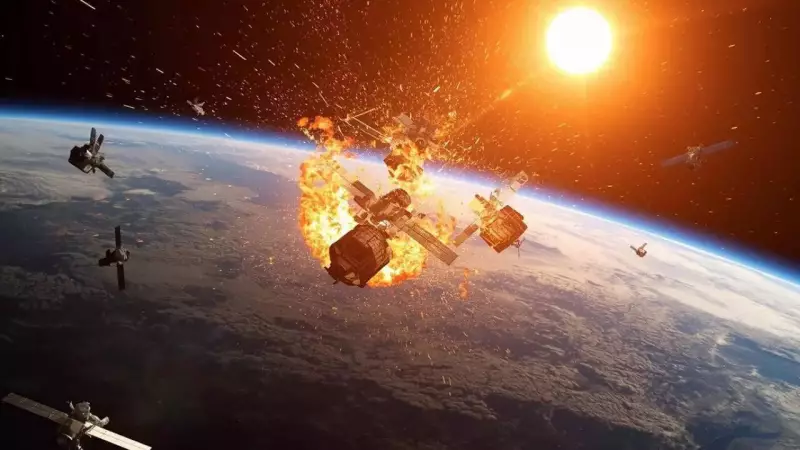
The ultimate nightmare scenario involves a high-intensity solar storm causing total system failure in multiple satellites. An unresponsive satellite becomes a deadly hazard, incapable of avoiding impacts. A single collision could generate a cloud of space debris, placing countless other satellites at risk. This could initiate a chain reaction of failures—a phenomenon known as the Kessler Syndrome—potentially leading to the collapse of entire constellations and rendering critical orbital regions unusable for generations.
Beyond the immediate collision risk, scientists are also worried about other consequences. The constant launch of rockets and the re-entry of satellites are polluting Earth's upper atmosphere. Furthermore, the sheer number of satellites is creating light and radio interference, hampering astronomical observations and other signals.
The message from the research is clear: the commercial space boom has brought benefits but also immense, unmanaged risks. With the CRASH Clock ticking down to just 2.8 days, the call for robust international regulation, better debris mitigation, and more resilient satellite technology has never been more urgent. The stability of our shared orbital commons depends on swift and decisive action.






