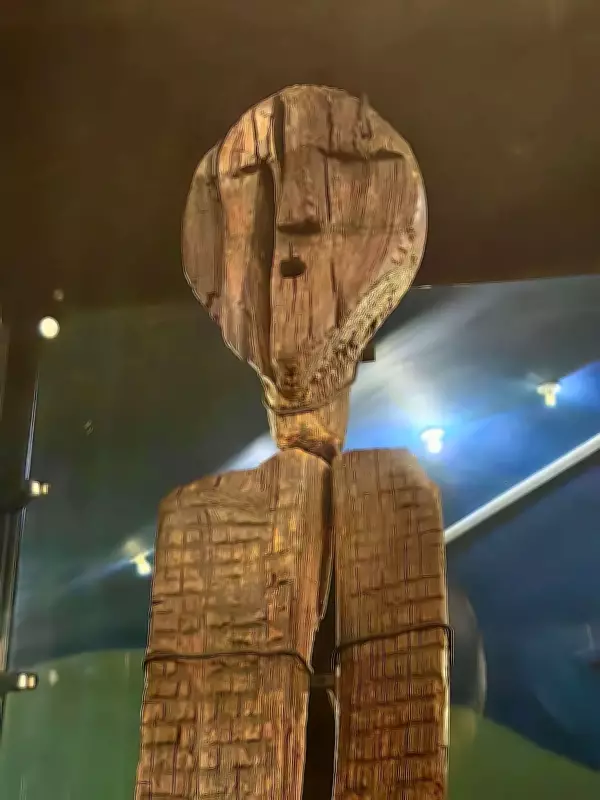
The greatest secrets of Earth are not always golden treasures buried in ancient tombs. On a bitterly cold winter day in 1890, a group of gold miners excavating in the Ural Mountains of Russia stumbled upon something far more valuable than precious metals. While digging in the swampy, water-soaked soil of Shigir, they uncovered a series of enormous wooden carvings adorned with strange, geometric inscriptions. Once the pieces were assembled, scientists realized they were looking at a towering, anthropomorphic wooden statue. The monument featured a distinct, haunting human-like head at the top, along with several subtle faces etched along its length. Today, this terrifyingly beautiful artifact is known as the Shigir Idol, and it has shattered everything historians thought they knew about the artistic capabilities of early human societies.
Preservation in a Peat Bog
What truly makes this monument so remarkable is its survival. Under normal conditions, organic matter such as wood would deteriorate to nothingness within a few decades. However, the unique environment of the peat bog acted as a natural time capsule, halting microbial decay and preserving the artifact so well that the marks left by its creator remain clearly visible. This ancient giant has defied the historical timeline.
Age Revealed by Radiocarbon Dating
For many years, the actual age of this wooden sculpture posed a significant question for scientists worldwide. As stated in an archaeological report published in the journal Antiquity, modern radiocarbon dating methods have astonished the scientific community by revealing that the monument was carved from a huge larch tree approximately 12,100 years ago. This makes the Shigir Idol more than twice as old as the Egyptian pyramids and Stonehenge. It was created at the dawn of the Holocene era, a time when humans were still living as nomadic hunter-gatherers.

This incredible discovery utterly destroys the historically held belief that sophisticated stone monuments were invented by later, more stationary agricultural civilizations. It demonstrates that prehistoric people who roamed the postglacial wilds possessed an extremely rich spiritual world and advanced woodworking abilities long before any other civilization on the planet. The intricate geometric carvings may represent an ancient coded message or a map of the world, with figures depicting deities or mythological beings.
Decoding an Ancient Message
The exterior of the monument features a mesmerizing pattern of abstract geometric shapes, including zigzags, straight lines, and chevrons. As described in an article published in Smithsonian Magazine, many archaeologists believe these designs are part of a coded message or an ancient map of the world. The monument stands as a striking reminder that the human urge to express complex abstract ideas, create art, and tell grand stories is deeply embedded within our species. The creators used sharp stone tools to engrave their worldview onto a single piece of wood, leaving a message that traveled across twelve millennia to puzzle modern minds.
Today, the original monument is carefully guarded behind glass cases in a Russian museum, continuing to challenge our understanding of prehistoric human potential. It makes us think about how many other masterfully crafted wooden monuments must have vanished into dust over the centuries, leaving only a tiny handful of lucky bog discoveries to tell the story of our deepest past. How amazing and humbling to think that even as contemporary civilizations come and go through millennia, there exists one piece of carved wood from a tree that, for 12,000 years, has been patiently preserving the thoughts of an individual who gazed up into the heavens.