

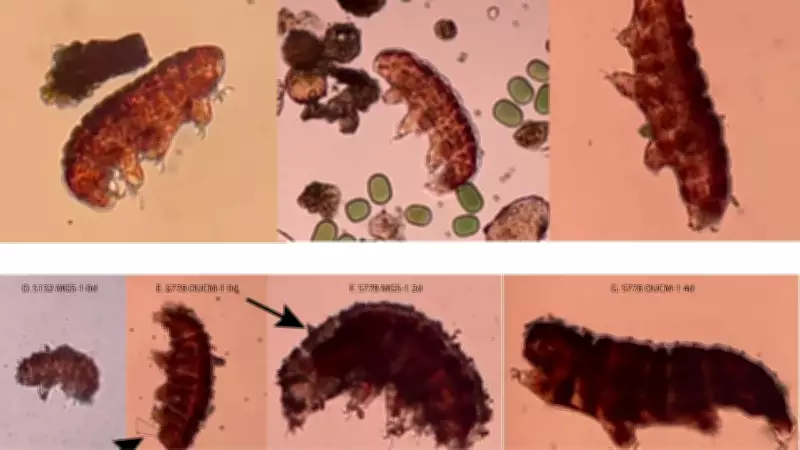
Penn State Researchers Study Tardigrade Proteins for Mars Survival and Bio-Inspired Materials
Scientists at Penn State University are investigating the extraordinary resilience of tardigrades, commonly known as 'water bears,' to understand how living organisms might protect Martian resources and enable long-term human habitation. These microscopic extremophiles are renowned for surviving in the vacuum of space, but this study specifically examines their molecular responses to Martian-like conditions, focusing on the proteins that safeguard their DNA and cellular structures.
Molecular Mechanisms of Tardigrade Survival
Researchers have identified a novel class of 'disordered proteins' that lack a well-defined three-dimensional structure. When tardigrades encounter extreme stress, such as the intense radiation or low humidity typical of Martian environments, these proteins form a biological glass around their DNA and critical cellular components. This protective glass-like coating likely prevents cellular damage or shattering, allowing the organisms to endure harsh conditions that would be lethal to most life forms.
The study reveals that tardigrades enter a dormant state called cryptobiosis, but the Penn State team is delving deeper into the precise molecular pathways that enable this survival strategy. By decoding these mechanisms, scientists aim to engineer synthetic countermeasures against extreme radiation and desiccation, which are crucial for future planetary exploration missions.

Biotechnological Applications for Space Exploration
The findings from this research offer significant insights for biotechnological applications in space expeditions. Key potential uses include:
- Developing protective coatings for sensitive technologies like electronics and pharmaceuticals, shielding them from cosmic radiation and temperature extremes on Mars.
- Creating bio-inspired materials that mimic tardigrade proteins to build resilient habitats and infrastructure, reducing the need for heavy shielding on spacecraft.
- Engineering self-repairing or ultra-durable materials based on biosynthetic analogues of tardigrade proteins, which could lead to longer-lasting construction solutions for Martian colonies.
This shift from passive observation to active engineering of protective systems represents a major advancement in sustaining human life on Mars over extended periods.
Implications for Mars Habitability and Beyond
By demonstrating how Earth organisms like tardigrades can survive in Martian-like environments through specific molecular pathways, this research expands the definition of habitability. It provides a framework for assessing the potential of other extraterrestrial bodies to support life. Essentially, if these biological models can be adapted, survival on Mars becomes an engineerable biological process rather than relying solely on mechanical endurance.
For organizations like NASA, this biological blueprint is essential for advancing long-term plans to establish a sustained human presence on the Moon and Mars. The study not only aids in identifying conditions for possible habitation but also offers a model for developing resilient, bio-inspired materials that could protect critical infrastructure and biological assets on the Martian surface.
In summary, the Penn State research on tardigrades is paving the way for innovative solutions in space exploration, leveraging nature's survival strategies to overcome the challenges of interplanetary colonization.






