

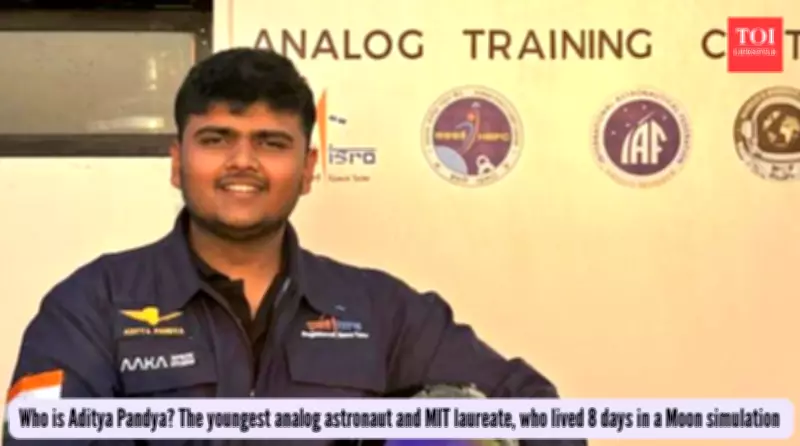
Indian Teen Makes History as Youngest Male Analog Astronaut in Lunar Simulation
India's space exploration narrative is accelerating at an unprecedented pace, capturing the nation's collective imagination. Following landmark achievements like Chandrayaan-3, space has transformed from a distant aspiration into a tangible frontier for the next generation. This shift is powerfully embodied by 17-year-old Aditya Pandya, who has now etched his name in history as India's youngest male analog astronaut after successfully completing a rigorous Moon-like simulation mission.
Pioneering Mission in Gujarat's Lunar Landscape
Aditya Pandya, a prodigious engineering mind from Gujarat, undertook an intensive eight-day lunar simulation from February 1 to 8 in the stark, Moon-resembling terrain of Dholavira in Kutch. The mission was orchestrated by AAKA Space Studio, an organization registered as an ISRO Space Tutor specializing in planetary analog research. Alongside three fellow crew members, Aditya inhabited a specially designed container-style habitat engineered to replicate the harsh, isolated conditions astronauts would encounter on the lunar surface.
For the entire duration, the team operated under strict isolation protocols, completely severed from external communication and dependent on limited onboard resources for sustenance and life support. This immersive experience mirrored the psychological and physical challenges of actual space missions, providing invaluable data for future lunar expeditions.

Engineering Prodigy Designs His Own Living Systems
What distinguishes Aditya's achievement is his dual role as both crew member and chief systems architect. During the six-month preparation phase, he personally designed, tested, and implemented critical habitat technologies. His innovations included sophisticated air-quality monitoring sensors, advanced biometric systems for real-time crew health tracking, and robust fault-detection hardware. Utilizing 3D printing for rapid prototyping, Aditya ensured these systems were both efficient and reliable.
The habitat featured a cutting-edge digital twin system that synchronized live data with mission control, continuously monitoring oxygen levels, health metrics, and other vital parameters. While peers his age focused on academic examinations, Aditya was stress-testing technology destined for extraterrestrial environments, demonstrating exceptional technical prowess and visionary thinking.
Academic Excellence and Specialized Training
Aditya's academic journey reflects his multidisciplinary approach to space technology. He completed his intermediate education at Asia English School with concentrations in Science, Mathematics, and Artificial Intelligence. Between February and April 2025, he earned a certification in Generative AI for data-driven business decision-making and simultaneously completed a related course from the prestigious Massachusetts Institute of Technology. Currently, he is pursuing Computer Engineering at the Institute of Advanced Research in Gandhinagar, blending theoretical knowledge with practical innovation.
Life Inside the Simulated Lunar Habitat
Existence within the Moon mock-up was deliberately challenging, designed to test human endurance and adaptability. The crew adhered to rigorous space-style regulations, including complete isolation, restricted supplies, and total reliance on onboard systems for food and atmospheric control. Over eight days, they conducted studies on psychological impacts of isolation, human-machine interaction in confined spaces, and decision-making processes in detached environments.
According to reports from ANI, Aditya's custom-built systems performed flawlessly under pressure, maintaining functionality throughout the mission. The habitat itself replicated lunar living conditions with cramped quarters, resource recycling, and constant environmental monitoring, all crucial for preparing future astronauts for long-duration missions.

Strengthening India's Analog Research Ecosystem
AAKA Space Studio emphasized that this mission aimed to bolster India's analog research infrastructure by integrating hands-on engineering, simulation science, and authentic astronaut training. Aditya's unique experience of inhabiting systems he personally engineered represents a rare convergence of engineering and astronautics, setting a new benchmark for youth involvement in space research.
This achievement not only highlights individual brilliance but also signals a broader transformation in India's space ambitions, where young innovators are actively shaping the future of interplanetary exploration. As India continues to expand its cosmic footprint, pioneers like Aditya Pandya are proving that the final frontier is increasingly within reach for the nation's youth.





