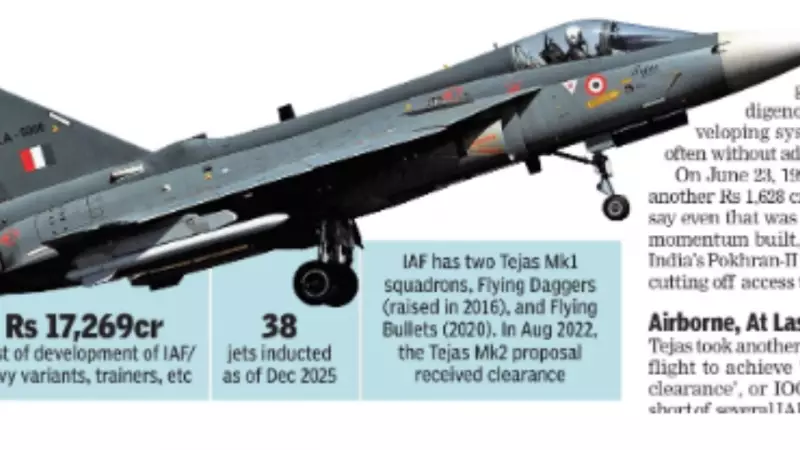
On a clear Thursday morning, January 4, 2001, a sleek, compact fighter aircraft began its roll down the runway at the Hindustan Aeronautics Limited (HAL) airport in Bengaluru. For Wing Commander Rajiv Kothiyal, the Indian Air Force (IAF) test pilot at the controls, the moment was the culmination of years of preparation. As the aircraft lifted off, it carried with it the weight of a nation's decades-long ambition to achieve self-reliance in combat aviation.
The Historic 18-Minute Maiden Flight
At precisely 10:18 AM, after extensive pre-flight checks, Wg Cdr Kothiyal eased the then-unnamed Light Combat Aircraft (LCA) into the sky. The first flight lasted 18 minutes, a period that symbolised a leap of faith for India's aerospace sector. The flight proceeded largely as planned, despite a critical telemetry failure minutes after take-off which caused all 16 monitoring screens in the control room to flash incorrect data. Trusting his instincts and the aircraft, Kothiyal pressed on with the sortie.
The meticulous planning for this day began early. At 8 AM, Kothiyal conducted a detailed briefing, outlining the flight profile and coordinating with the pilots of two Mirage-2000 chase aircraft tasked with monitoring the flight. Strapped into the cockpit by 9:15 AM, he mentally rehearsed manoeuvres, many of which had been practised during hundreds of hours in a Mirage simulator. The aircraft, powered by a GE-F404 engine, underwent a lengthy 12-minute automatic built-in test before finally receiving the "GO" for take-off.

A Long and Arduous Development Saga
The journey of the Tejas began long before that first flight. While the formal project approval with funding of Rs 560 crore came in 1983, the conceptual seeds were planted in the late 1970s. This was after India realised further development of the HF-24 Marut fighter was not feasible. In 1979, Professor Roddam Narasimha conceived an aircraft with limited range but maximum performance, a proposal that gained momentum with the backing of nuclear physicist Professor Raja Ramanna.
With no single Indian organisation capable of such a complex undertaking, the government established the Aeronautical Development Agency (ADA) in 1984 to lead the design, with HAL as the production partner. Progress was painstakingly slow. By the early 1990s, the programme teetered on the brink of cancellation. Its survival at this critical juncture is credited to the intervention of industrialists Ratan Tata and Rahul Bajaj. A high-level panel they were part of reviewed the project in 1991, with Tata reportedly stating that shelving it would be "a shame" and even offering to take it over if the government abandoned it.
The challenges were relentless. The 1991 foreign exchange crisis forced a shift to a fully indigenous strategy under Prime Minister P.V. Narasimha Rao. Later, sanctions imposed after India's 1998 Pokhran-II nuclear tests cut off access to key international technologies, further complicating development.
From First Flight to Operational Service
The path from that first flight to operational service was long. The aircraft was officially named 'Tejas' by then Prime Minister Atal Bihari Vajpayee in 2003. It achieved Initial Operational Clearance (IOC) only a decade after its maiden flight, in 2011, and even then, it required further improvements. The programme has been a mix of significant achievement and ongoing debate regarding its capabilities and timelines.
Despite multiple government orders, concerns about pace persist. As recently as February 2025, IAF Chief Air Chief Marshal A.P. Singh expressed a lack of confidence in HAL due to delays in improvements and deliveries. The parallel Kaveri engine programme, started in the 1980s, failed to deliver, leaving the Tejas reliant on American GE engines. The naval variant, though developed and tested, saw the Navy look elsewhere for its immediate needs due to delays.
Over a quarter-century of flying, the Tejas fleet has recorded two crashes—one fatal in Dubai in November 2023 and another near Jaisalmer in 2024 where the pilot ejected safely.

A Legacy of Perseverance
The story of the Tejas is not a simple narrative of triumph or failure. It stands as India's only indigenously developed fighter to enter IAF service, a undeniable technological milestone. It represents a hard-earned lesson in the complexities of aerospace design and the relentless perseverance required for strategic self-reliance. The aircraft's journey, from a thought in the late 1970s to a squadron-ready fighter, underscores both what India has achieved and the considerable distance it must still travel to claim full mastery over combat aircraft design.