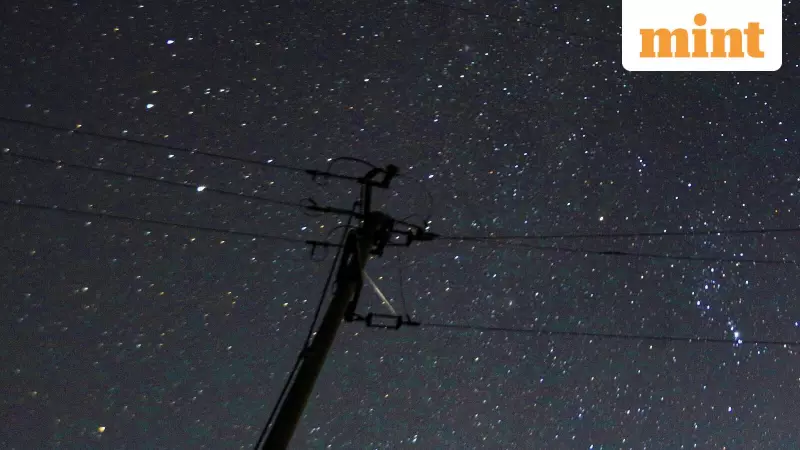
As the year draws to a close, the night sky has one final gift for stargazers across India and the Northern Hemisphere: the Ursid meteor shower. This annual celestial event, often overshadowed by its more prolific December neighbour, the Geminids, is currently active and will reach its peak intensity around the December solstice in 2025, offering a serene and beautiful display of "shooting stars" under exceptionally dark skies.
Ursid Meteor Shower 2025: Peak Timing and Ideal Conditions
Mark your calendars for the prime viewing window. According to the American Meteor Society, the best time to observe the Ursids in 2025 will be from the evening of December 21 through the dawn of December 22. The shower's predicted maximum activity is centred around 11 UTC on December 22. The active period spans from December 17 to December 26, but the peak nights promise the most activity.
This year, lunar conditions are exceptionally favourable for meteor watchers. The moon will be a mere 3% full, following a new moon on December 20. This translates to gloriously dark skies, free from the interfering glow of moonlight, making even faint meteors easier to spot. While the Ursids are generally a modest shower with a Zenithal Hourly Rate (ZHR) of around 10, observers under clear, dark skies can expect to see 5 to 10 meteors per hour during the peak.

How and Where to Watch the Ursids from India
The Ursids are primarily a spectacle for the Northern Hemisphere. Observers in mid-to-high northern latitudes, which includes all of India, have the best seats for the show. The shower's radiant point—the area in the sky from which the meteors appear to originate—lies near the constellation Ursa Minor, home to the Little Dipper. This position is circumpolar for many northern viewers, meaning it remains above the horizon throughout the night.
No special equipment is needed to enjoy this natural fireworks display. Here are some expert tips for the best experience:
- Escape light pollution: Get as far away from city lights as possible for the darkest sky.
- Be patient: Allow your eyes 20 to 30 minutes to fully adapt to the darkness.
- Stay screen-free: Avoid looking at your phone or any bright lights to preserve your night vision.
- Get comfortable: Use a reclining chair or a sleeping bag, dress very warmly, and simply look up.
The Science Behind the Ursid Meteor Shower
This beautiful display has a specific cosmic origin. The Ursid meteors are debris from Comet 8P/Tuttle, a short-period comet that orbits our Sun every 13.5 years. As Earth journeys along its orbital path, it plows through the trail of ice and dust particles left behind by the comet. When these tiny particles, often no larger than a grain of sand, collide with Earth's atmosphere at tremendous speeds of about 20.5 miles per second (33.1 km/s), they vaporise due to friction, creating the bright, fast streaks of light we call meteors.
While the Ursids are often overlooked due to their timing just before Christmas and after the dazzling Geminids, they hold a special charm for dedicated skywatchers. Historically, the shower has surprised observers with rare outbursts where rates have exceeded 100 meteors per hour, and even unpredictable surges of 25+ per hour are possible. This element of quiet potential, combined with the perfect dark skies of 2025, makes the final meteor shower of the year a peaceful and potentially rewarding astronomical event not to be missed.