

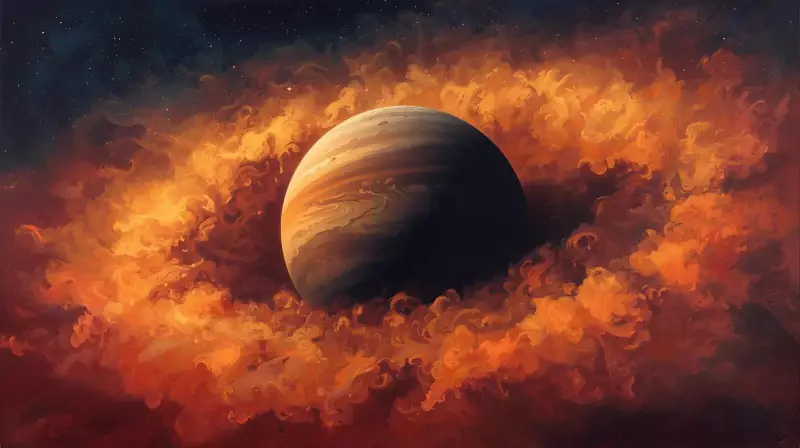
Often called Earth's twin due to its similar size and structure, Venus is one of the most fascinating and extreme planets in our solar system. But beneath that superficial resemblance lies a world of shocking contrasts—a hellish landscape that challenges our understanding of planetary evolution and offers crucial clues about the future of habitability.
The Hellish Reality of Earth's Twin
Despite being Earth's sibling in size, Venus presents an environment that is utterly hostile. The planet is shrouded in thick clouds of sulfuric acid, creating a permanent, toxic overcast. Surface temperatures soar to a staggering 475 degrees Celsius, hot enough to melt lead, making it the hottest planet in our solar system—even hotter than Mercury, which is closer to the Sun.
This inferno is driven by a runaway greenhouse effect within its incredibly dense atmosphere, which is composed mostly of carbon dioxide. The atmospheric pressure on the Venusian surface is 92 times greater than Earth's, equivalent to the pressure found nearly a kilometre underwater on our planet. This crushing pressure poses immense challenges for any spacecraft attempting to land and survive.

Unraveling Venus's Bizarre Behavior
Venus is a planet of strange motions and features. It rotates on its axis incredibly slowly, with a single day lasting 243 Earth days. Even more peculiar is its retrograde rotation; it spins backwards compared to most planets. If you could stand on Venus, you would witness the Sun rising in the west and setting in the east. Scientists theorize a colossal collision with another celestial object in the distant past may have caused this backward spin.
Adding to the oddity, the planet's upper atmosphere whips around Venus at astonishing speeds, completing a full circle in just four Earth days with winds exceeding 360 kilometres per hour, while the planet itself barely turns below.
A Volcanic World with a Possible Habitable Past
Venus is the most volcanic planet we know, dotted with more than 1,600 major volcanic structures. Vast lava plains indicate that volcanic activity has been the dominant force in shaping its surface for most of its history, and there is evidence suggesting some volcanoes may still be active today.
Intriguingly, data suggests Venus may not have always been a hellscape. Evidence points to a time, two to three billion years ago, when it might have had liquid water and a much milder climate, potentially even habitable conditions. This dramatic transformation into an acidic oven holds vital lessons for understanding climate change and the delicate balance required for a planet to sustain life.
Why Scientists Keep Probing Its Secrets
Venus's extreme nature makes it a compelling scientific target. It has no moons or rings, a mystery that may be tied to its unique formation. Its brilliant, cloud-covered surface reflects 75% of sunlight, making it the brightest planet in our night sky, often called the Morning Star or Evening Star.
Despite the harsh environment, numerous missions have dared to study it, including the Soviet Venera probes, NASA's Magellan, and ESA's Venus Express. Each mission has peeled back a layer of mystery. Upcoming expeditions are eagerly awaited to uncover more about its origin and evolution.
Studying Venus is not just about understanding a distant world; it is a crucial mirror for Earth. By deciphering how and why Venus became an uninhabitable greenhouse, scientists gain invaluable insights into planetary climate processes, the evolution of rocky worlds, and the fragile conditions that allow life to thrive—or perish.






